
On the Trail
The Pequot Trail
Bashert is a Yiddish word meaning “destiny.” It is most commonly used in reference to a romantic partner or soulmate, but it can also point one toward a predestined purpose or path.
By Bob Andrews
Early in the 1990s, I was a scoutmaster on a three-day hike with a group of Boy Scouts on the Connecticut portion of the Appalachian Trail. We were going up a very steep section, feeling proud of our ability to carry our backpacks and gear. Coming the other way was a group doing trail maintenance. They had just gone up and over the same hill carrying backpacks and bulky tools, working as they passed us. We were humbled and impressed. They said they were with the local Appalachian Mountain Club chapter. When I got home, I made contact and joined the AMC. After a few hikes and volunteer events, I found there was another organization, the Connecticut Forest and Park Association, that maintains another 800+ miles of trails, and I joined that organization as well. I found out that CFPA had an upcoming vacancy among their trail managers. They asked if I would take over the Pequot Trail.
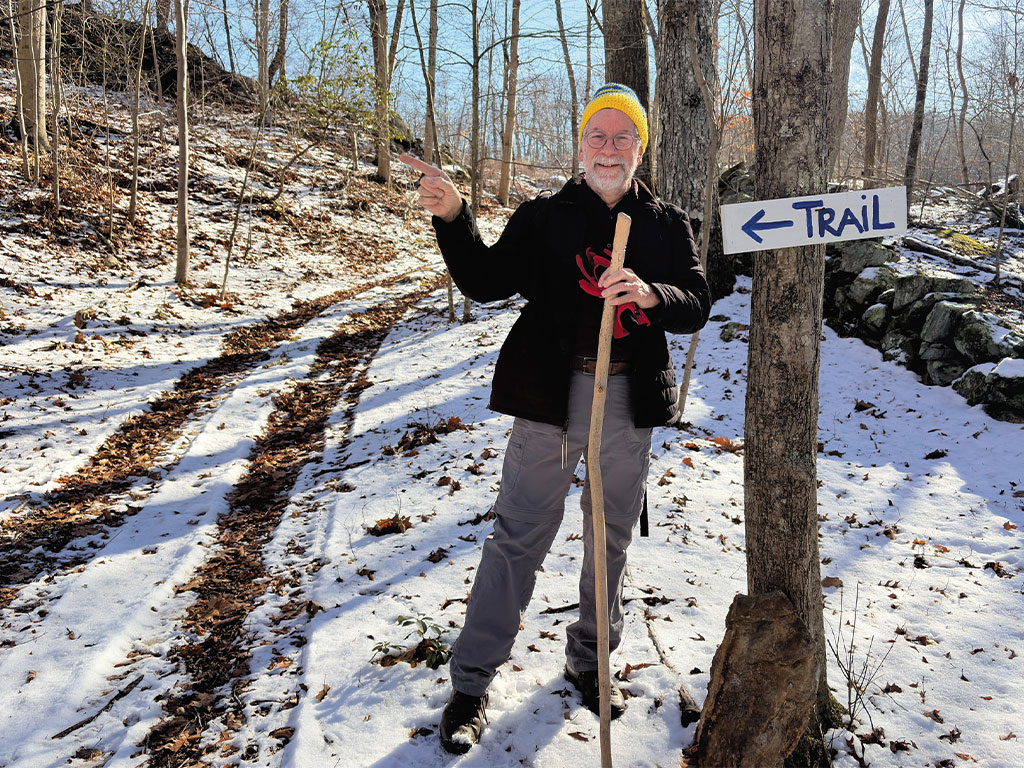
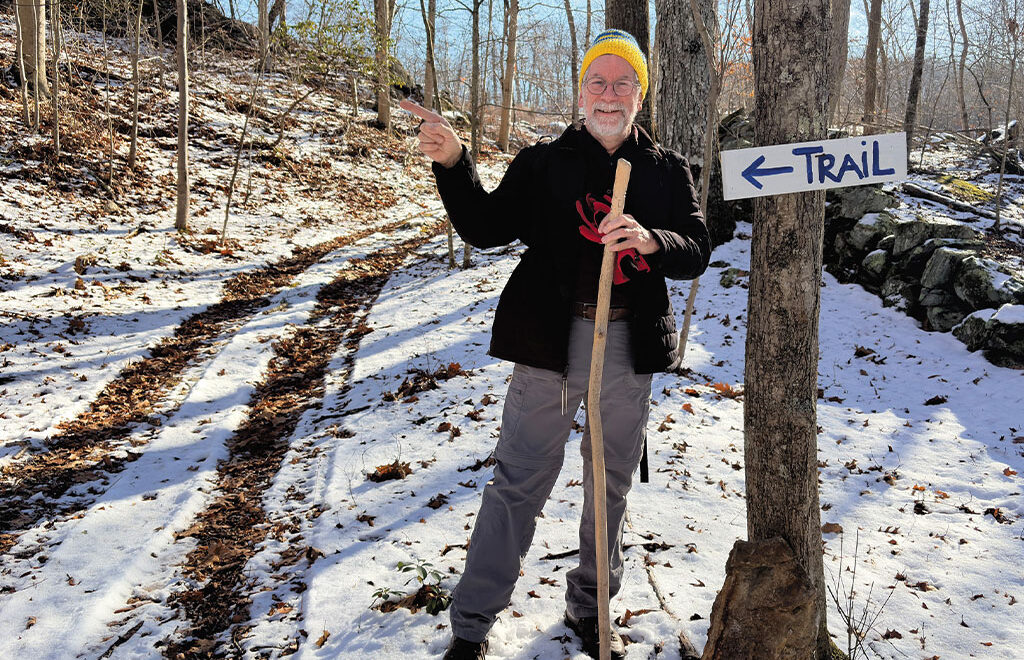
Snowy forest trail
Pequot? What were the chances? Bashert. I was born in a lakeside cottage in Ellington, Connecticut called “Pequot Lodge.” In 1985, when my aunt passed away, she left me a house on Pequot Avenue in New London. My children grew up there, and my son Greg joined Boy Scouts and became a member of the Pequot District of the Indian Trails Council. When redevelopment came to New London and bought our home, we moved to Ledyard where our next-door neighbor was a member of the Pequot tribe. His and much of the neighborhood property was owned by the tribe or tribal members. I bought a membership to the Mashantucket Pequot Museum.
One other thing: I’m a direct descendent of the colonists who perpetrated the massacre of Pequot tribal members at Mystic Fort in 1637. I have now been managing the Pequot Trail for over 25 years, and my family history is often on my mind as I work. There is a marker near a high point of the trail where Indigenous artifacts were found by a previous landowner. I have paused there a few times to consider the questions of my connection to this place and its history. Am I here just to keep the trail clear, or am I making some reparation for the guilt of my ancestors? Either way, it feels right to do everything I can to respect and protect the land.
On a more cheerful note, there has been a continuing effort by CFPA to improve the Pequot Trail and uphold its Indigenous history. The original route of the trail included a connection to the Narragansett Trail on Lantern Hill. In 1979, construction of Mashantucket Pequot tribal homes, roads, and a museum required the shutdown of that section. A long-term effort by CFPA and the tribal Natural Resource Protection staff has identified a possible reroute. In 2015, another reroute was made in response to a request by the tribe to move a short section away from the sacred burial ground to protect it from accidental intrusions. The trail now steers clear of that part of the reservation property.
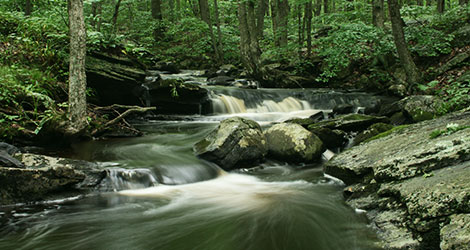
A 30-year effort by local groups to create the Tri-Town Trail from the Long Island Sound to the Pequot is now in a construction phase. The biggest overhaul of the trail was made necessary by the power company upgrading a high voltage line and replacing its wooden towers with larger steel towers. The power company constructed a new road and bulldozed two miles of the Pequot Trail, which closed half of the trail for two years. Some of that section has now been rerouted, re-blazed, and will be under rehabilitation for a few years. South of that reroute, part of a road walk has been eliminated by moving the trail into a wooded area that follows a stream often used by fishermen and wildlife photographers.
Early in the 1990s, I was a scoutmaster on a three-day hike with a group of Boy Scouts on the Connecticut portion of the Appalachian Trail. We were going up a very steep section, feeling proud of our ability to carry our backpacks and gear. Coming the other way was a group doing trail maintenance. They had just gone up and over the same hill carrying backpacks and bulky tools, working as they passed us. We were humbled and impressed. They said they were with the local Appalachian Mountain Club chapter. When I got home, I made contact and joined the AMC. After a few hikes and volunteer events, I found there was another organization, the Connecticut Forest and Park Association, that maintains another 800+ miles of trails, and I joined that organization as well. I found out that CFPA had an upcoming vacancy among their trail managers. They asked if I would take over the Pequot Trail.
Pequot? What were the chances? Bashert. I was born in a lakeside cottage in Ellington, Connecticut called “Pequot Lodge.” In 1985, when my aunt passed away, she left me a house on Pequot Avenue in New London. My children grew up there, and my son Greg joined Boy Scouts and became a member of the Pequot District of the Indian Trails Council. When redevelopment came to New London and bought our home, we moved to Ledyard where our next-door neighbor was a member of the Pequot tribe. His and much of the neighborhood property was owned by the tribe or tribal members. I bought a membership to the Mashantucket Pequot Museum.
One other thing: I’m a direct descendent of the colonists who perpetrated the massacre of Pequot tribal members at Mystic Fort in 1637. I have now been managing the Pequot Trail for over 25 years, and my family history is often on my mind as I work. There is a marker near a high point of the trail where Indigenous artifacts were found by a previous landowner. I have paused there a few times to consider the questions of my connection to this place and its history. Am I here just to keep the trail clear, or am I making some reparation for the guilt of my ancestors? Either way, it feels right to do everything I can to respect and protect the land.
On a more cheerful note, there has been a continuing effort by CFPA to improve the Pequot Trail and uphold its Indigenous history. The original route of the trail included a connection to the Narragansett Trail on Lantern Hill. In 1979, construction of Mashantucket Pequot tribal homes, roads, and a museum required the shutdown of that section. A long-term effort by CFPA and the tribal Natural Resource Protection staff has identified a possible reroute. In 2015, another reroute was made in response to a request by the tribe to move a short section away from the sacred burial ground to protect it from accidental intrusions. The trail now steers clear of that part of the reservation property.
A 30-year effort by local groups to create the Tri-Town Trail from the Long Island Sound to the Pequot is now in a construction phase. The biggest overhaul of the trail was made necessary by the power company upgrading a high voltage line and replacing its wooden towers with larger steel towers. The power company constructed a new road and bulldozed two miles of the Pequot Trail, which closed half of the trail for two years. Some of that section has now been rerouted, re-blazed, and will be under rehabilitation for a few years. South of that reroute, part of a road walk has been eliminated by moving the trail into a wooded area that follows a stream often used by fishermen and wildlife photographers.
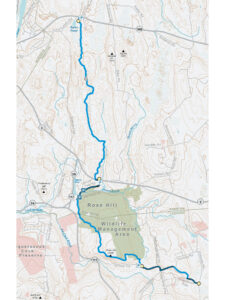
For the latest trail location info, visit CFPA’s online trails map
Hiking any of Connecticut’s trails, it is worthwhile to take your time and consider how the land came to be as it is now. On an early fall morning, walk quietly on the Pequot Trail, and you will have more than birds and squirrels for company. History is imprinted on the land. Imagine thousands of feet of ice crushing giant boulders across the surface, creating stream beds and carving the hills. Listen for prehistoric animals passing by, long before the ice came and went. Hear the footfalls of thousands of Native Americans living here a few centuries ago. Or the colonial farmers raising sheep on land cleared by the construction of endless stone walls.
History is alive on this trail. Sometimes, I must remind myself that today, I am here to work. There is a blaze missing or a tree limb is down. I am meant to be here, to take care of this place. So, I tell myself: Get back to it.
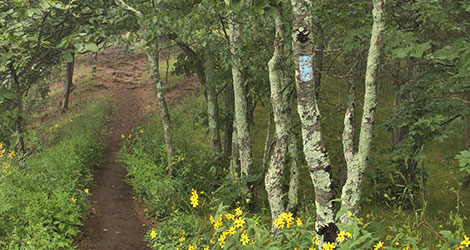
The Pequot Trail is not the most scenic trail in the CFPA inventory. There are few sweeping vistas or majestic stands of old growth timber. It is rarely hiked by organized hiking groups. Even some of its neighbors are unaware of its existence. But I still recommend taking a winter’s day walk through snow-covered pines, across wetlands still alive with that one beaver and two Canada Geese. Perhaps you will get the feeling you were meant to be here, too.
Bob Andrews is an accomplished sailor, computer geek, retired civilian Navy IT director for bases in the US and Iceland, and a Harley rider who enlisted in the Navy as a Russian Translator. He writes bad poetry and dabbles in political activism and alternative energy systems. After 77 years in eastern CT, he now lives with his college sweetheart in Hartford. In his spare time, he hikes with his children and two grandsons in the Pachaug State Forest.
Learn more about the Pequot Trail