
Weathering Heights
Arborists embrace community and competition among the trees
By Timothy Brown. Photography by Jake Koteen
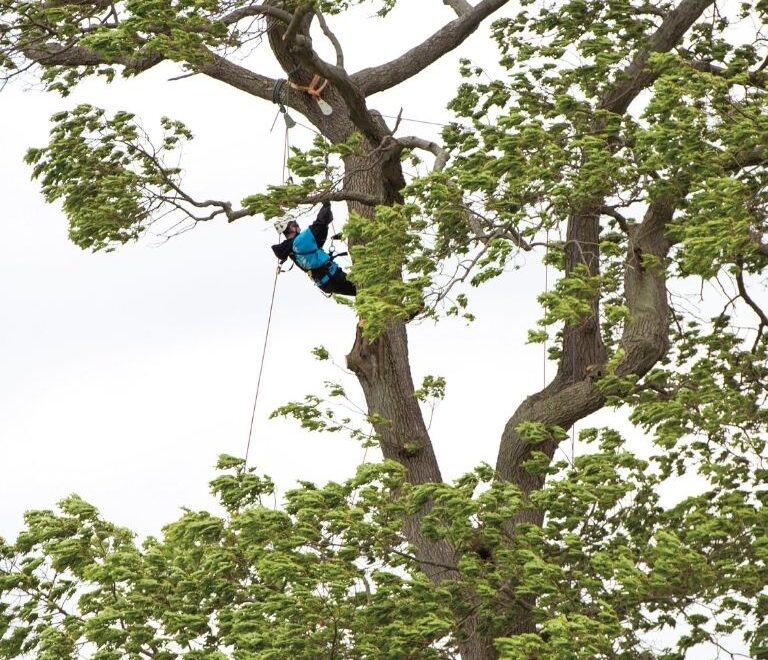
It’s a bitter and blustery Saturday morning when we arrive at New Haven’s Lighthouse Point Park. Though it’s nearly June, it feels more like March, and the Sound is frosted with whitecaps. Several spectators are huddled around a huge sycamore tree, their heads tilted toward the canopy. Fifty feet up, an arborist is racing against the clock to complete a series of assigned tasks in the face of a relentless wind.
We’re at the Connecticut Tree Climbing Competition, an annual event organized and hosted by the Connecticut Tree Protective Association, an educational nonprofit founded in 1922 to promote the protection and care of the state’s trees. Twenty-five contestants—all certified arborists—are competing in five events that simulate real-world challenges (minus any actual cutting): the ascent event, throwline accuracy, belayed speed climb, work climb, and aerial rescue. The top three climbers advance to the Master’s Challenge in the old sycamore. To the uninitiated, it looks like the nature version of American Ninja Warrior, with fans and arborists cheering on each other. While it’s certainly a contest, the atmosphere feels more congenial than competitive.
“The spirit of this industry and the spirit of this competition is learning and progressing at the trade, and everybody at these competitions is super supportive of each other,” says Jamie Chambrelli, National Safety Director for Canopy Service Partners, who serves as head tech for the competition. “When we get new climbers, more seasoned competitors will take them under their wing.”
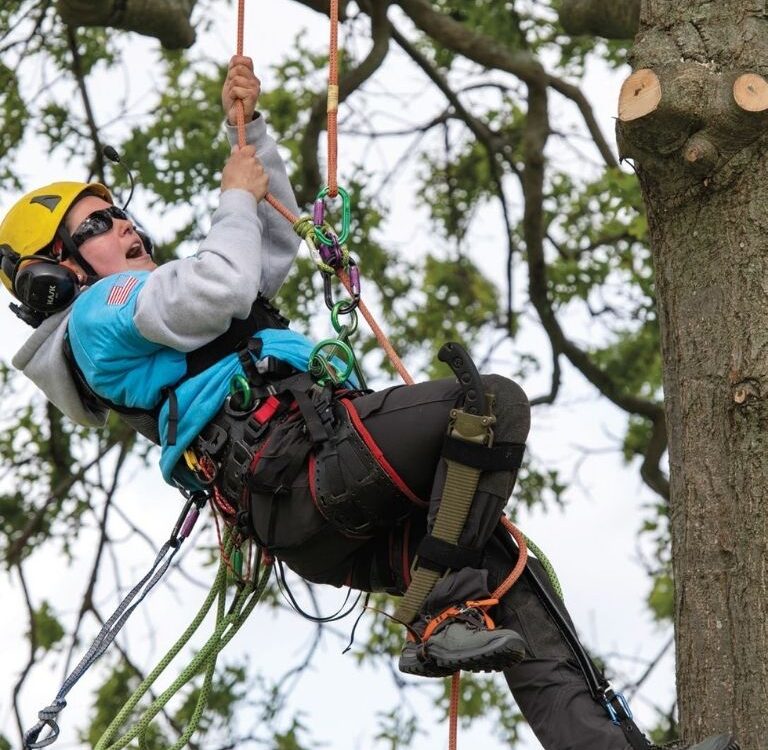
Alyssa Cleland calls out to a "dummy victim" during the timed Aerial Rescue, which replicated an actual rescue of an unconscious climber.
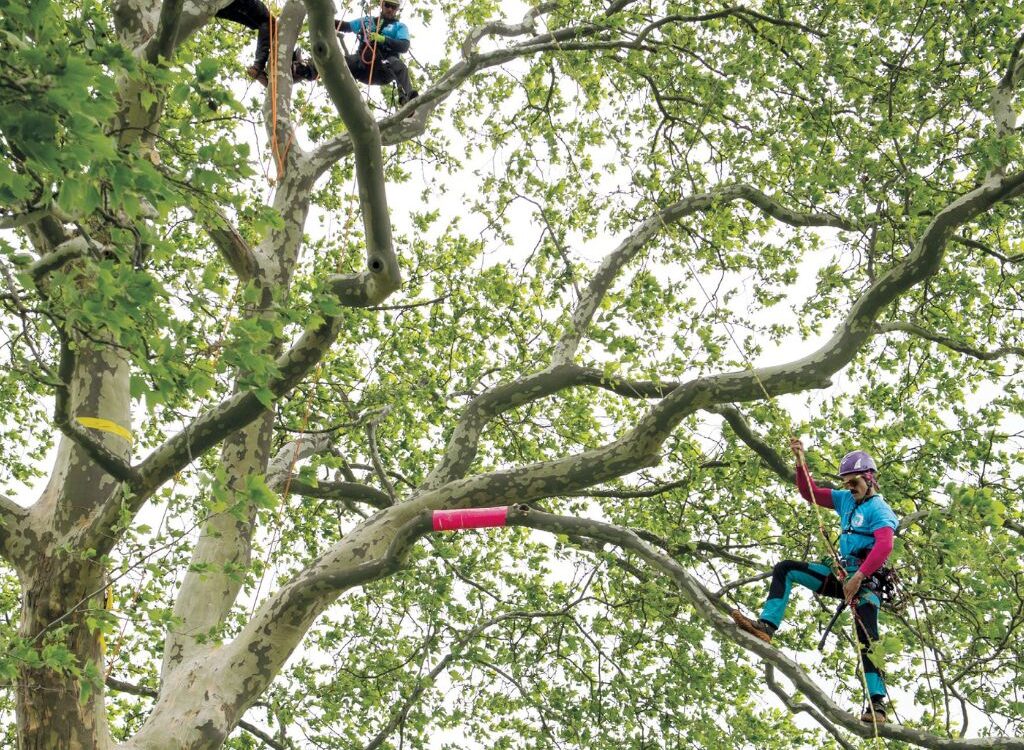
The Work Climb is the most challenging preliminary event. Contestants mush complete assigned tasks at five work stations throughout the tree and ring a bell when each task is complete.
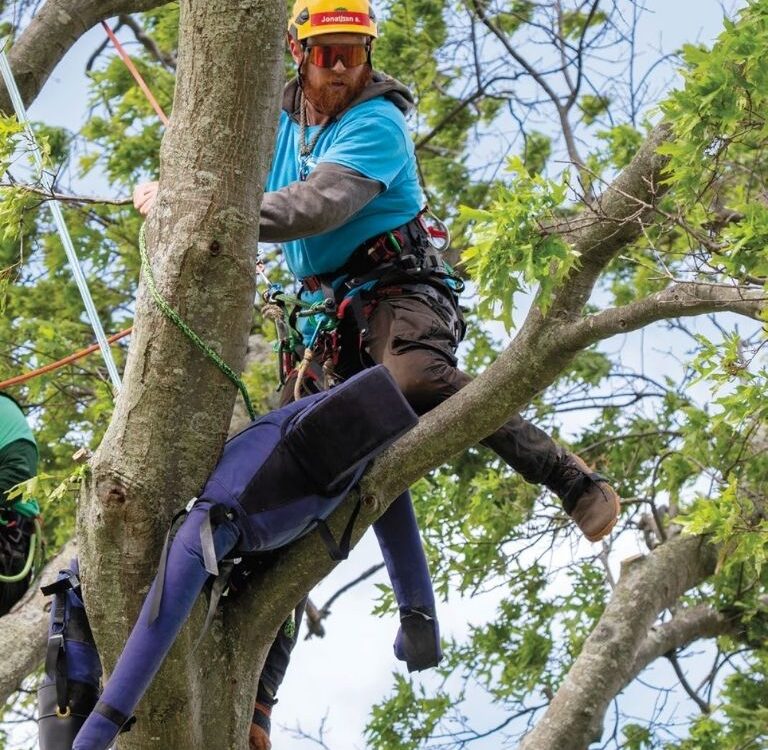
During the Aerial Rescue, climbers must "rescue" an unconscious climber, including lowering the dummy safely to the ground.
There’s something primal, almost instinctive, about climbing trees. Our evolutionary ancestors spent their lives swinging from limb to limb like modern day orangutans. And for many children, tree climbing is a beloved pastime. On this day, several children have braved the weather to support Dave Meszaros of Blue Collar Tree Service, who has performed tree work at their home and is competing for the fourth time. When asked why they like climbing trees, most of the kids respond with some variation of “to be up high.” But JL, age 8, also likes jumping out of trees (“not too high” he clarifies) and Jordan, 9, likes to find bird nests (blue jays are her favorite), while Gideon, 10, prefers napping in trees. The competition is held at a different park each year and is supported by a team of dedicated volunteers. “We scout out the trees that we think are going to be the best setup for each event,” says Chambrelli. “We clean out the dead wood and then show up the day before the competition and set up the trees.”
Most of the contestants are from Connecticut but the event attracts climbers from throughout New England. Alyssa Cleland, who grew up in Connecticut but now lives and works on Cape Cod, came to test her skills in the heavily male-dominated field.
“You’re constantly questioned, ‘Why do you want to be in this industry?’” she says. “I enjoy being outside; I enjoy working with my hands; I love the career. But there’s also so many good people.”
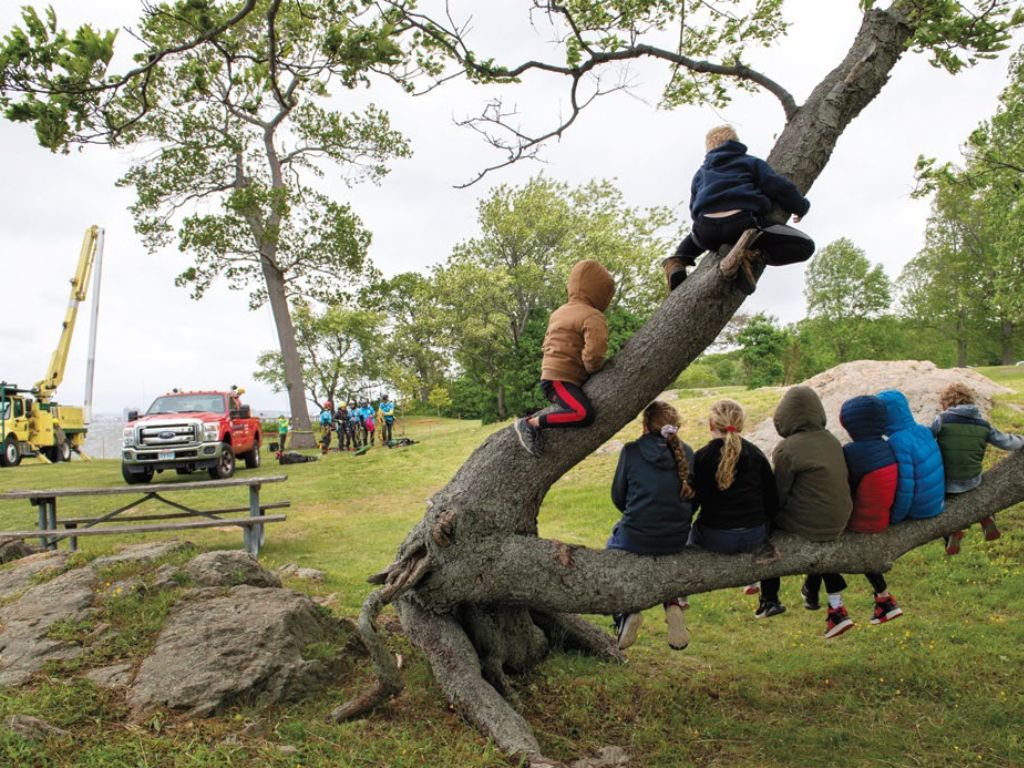
Kids watch the Ascent Event where climbers race up a tree, testing their skills and speed in setup (attaching themselves to the ascent line), ascending between 40 and 60 feet into the tree, and switching to descent gear.
Valentin Brito, 28, of Norwalk, a former competitive swimmer and lacrosse player agrees it’s all about the people. “Competing was what got me into it, but what kept me here is the community,” he says.
Brito, who earlier this spring won the North American Open Masters Tree Climbing Competition, ended up winning this year’s Connecticut Tree Climbing Competition, the first Mexican American to hold that title, and advanced to the New England Chapter International Society of Arboriculture Tree Climbing Championship in Rhode Island. But for Brito, winning isn’t what’s most important.
“It’s all about learning and growing together. Someone gets crowned victor, but at the end of the day, if you show up, you already won,” he says. “The stuff that I really enjoy are the memories that I get to build with all my other climbers and people that I meet throughout this journey.
Timothy Brown is a writer and editor based in New Haven.