


The Changing Landscape of Endangered Species Protections
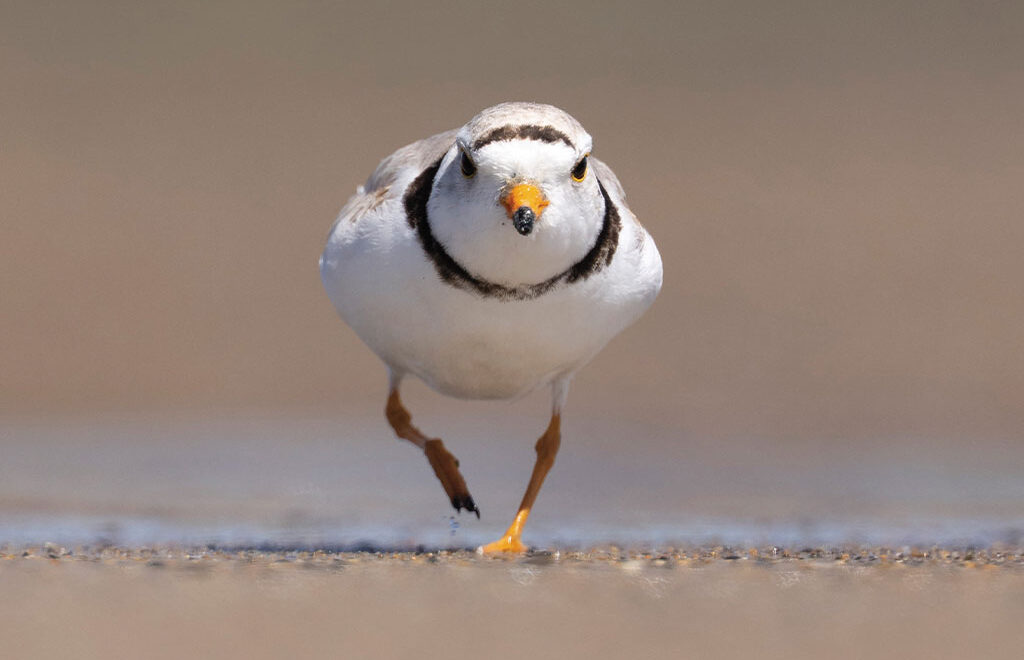
Piping plovers arrive in Connecticut each spring to nest on sandy beaches. Their options are limited here; Connecticut’s shoreline is a narrow strip, hemmed in by one of the most congested interstates in the country. And much of that narrow coastline is made up of rocky bluffs and wetlands. Piping plovers prefer the sandy strips of beach that also attract people, making it even harder for them to carve out safe spaces to lay their gray, speckled eggs. Climate change is squeezing out their options further, as sea levels rise and storms intensify.
Words by Britany Robinson
Photo by Todd DeWald
Despite all of these challenges, the plight of the piping plover has been a comeback story in Connecticut, thanks in large part to federal and state protections. The little sand-colored shorebirds are federally listed as “threatened” and therefore protected under the Endangered Species Act. In Connecticut, state and volunteer groups dedicate significant time and resources each year to setting up fencing and string enclosures, warning people to steer clear of the birds and their eggs. Volunteers patrol protected areas, ensuring the birds and their nests are not disturbed. In 2025, 166 piping plovers were monitored across 15 sites by Connecticut’s Department of Energy and Environmental Protection (DEEP)—the highest number of mating pairs since they began tracking in 1984.
“Our population is growing,” says Corrie Folsom-O’Keefe, Director of Bird Conservation for Audubon’s Connecticut and New York regional office. But she also warns that setbacks can unfold quickly when it comes to vulnerable species, and these numbers are still small. Protecting and monitoring their habitat and up and down the Atlantic seaboard will be critical work to the survival of piping plovers for generations to come.
In April of last year, while piping plovers were preparing to lay eggs in the sand, the Trump administration proposed a significant change to the Endangered Species Act, which would rescind the current definition of the word “harm” to exclude habitat protection. The administration claims that only intentionally killing or injuring a species should be considered “harm,” and that habitat destruction does not qualify.
“Woodpeckers are dependent on long leaf pine. Monarch butterflies can’t survive without milkweed,” says Mike Leahy, Senior Director of Wildlife Hunting and Fishing Policy at the National Wildlife Federation. “Everybody knows that wildlife needs habitat. This would be a huge setback to the recovery of a lot of species.”
Many strategies for recovering endangered and threatened species are based on incentivizing landowners to maintain the habitat these species need to survive. “Those programs are based on the fact that the habitat is protected by law,” says Leahy. “Once you remove the protections for habitat, you remove a big part of the incentives.”
Nationwide, 99% of federally listed species have been saved from extinction since the establishment of the Endangered Species Act in 1973. Success stories of the ESA, in which habitat protection played a significant role, include the bald eagle, gray wolf, peregrine falcon, Florida panther, and hundreds more. In a 2023 study conducted by The Society for Conservation Biology, five major threats to species and biodiversity were examined to determine the most significant. Of 30,000 species considered, 88% were impacted by habitat destruction—more than the other four threats combined.
In October, Leahy’s team was already collaborating with partner organizations, preparing to sue the administration for the exclusion of habitat protections in the ESA’s definition of “harm,” should this proposal become law. The following month, the U.S. Department of the Interior announced four more proposed rule changes to the ESA. These include removing a blanket rule that immediately protects threatened species upon listing, prior to the establishment of species-specific regulations; allowing economic considerations to be factored into the designation of critical habitat; limiting the scope of “foreseeable future” in considering the risk for a species to become threatened; and changing how interagency consultation is conducted.
These changes, “advance President Donald J. Trump’s directives to strengthen American energy independence, improve regulatory predictability and ensure federal actions align with the best reading of the law,” states the announcement from the U.S. Department of the Interior.
Backlash to these proposed changes from environmental groups and scientists has been swift and explicit. Over 600 scientists signed a letter, urging congress to protect the ESA, calling it “one of the most vital and effective tools we have to halt the accelerating loss of life on Earth.” They emphasize that failure to protect individual species will impact whole ecosystems and humans who rely on them, too.
They write: “These species and their connections to each other and the world around us underpin ecosystem services essential to human well-being: clean water, pollination, disease regulation, carbon storage, and climate resilience, to name a few. The ESA does not just protect wildlife; it protects the systems that support agriculture, economies, and communities.”
Over 10,000 faith leaders sent a similar letter to congress, calling the ESA a “modern-day Noah’s ark,” and rejecting the Trump agenda for rolling back protections. During the open comment period, according to EarthJustice.org, nearly 400,000 Americans submitted in opposition to the proposed changes.
This all comes at a time when biodiversity loss is an urgent concern to life on Earth. In the last 50 years, wildlife populations have declined by 69%, and about one million species are currently at risk of extinction. Biodiversity loss not only means the loss of individual species but also increased risk of infectious diseases. (Consider the increase of Lyme Disease in recent decades; with fewer mammals in our forests, ticks are feasting on humans.)
Federally Listed and Living in CT
These species are protected under the federal Endangered Species Act and live in Connecticut. Some of them are also included in Connecticut. Some of them are also included on Connecticut’s state-level ESA.
- Indiana Bat – Endangered: Population decline due to white nose syndrome and loss of forest habitat.
- Roseate tern – Endangered: Hunted for hats in the 1800s. The third largest colony in North America breeds on Faulkner Island.
- Bog Turtle – Threatened: The rarest turtle in Connecticut with isolated populations documented in just five towns.
- Dwarf wedgemussel – Endangered: Population limited to a few Connecticut River tributaries. Threatened by water pollution and dams.
- Puritan tiger beetle – Threatened: Found on sandy beaches and cliffs in just two states: Maryland and Connecticut.
The salt marsh sparrow is another seasonal resident facing habitat loss, and it’s been considered for federal protections in recent years. Folsom-O’Keefe says it’s important for them to be listed soon, as the population is currently declining by about 5% each year. But changes to the ESA could delay such listings.
The salt marsh sparrow is considered a key indicator species, meaning the health of its population is a reflection of the health of its ecosystem. Their declining numbers are a sign of struggling salt marshes, due to sea level rise and development. Efforts to protect them can protect other species, too, making the salt marsh ecosystem more resilient to climate change.
In an article for the U.S. Fish & Wildlife Service, MaryKelly Hilton writes, “Healthy coastal marshes not only provide wildlife habitat, but they protect the coast from flooding, provide clean water, and support multi-billion dollar fishery and tourism industries.”
Folsom-O’Keefe says if we can’t figure out how to make salt marshes more resilient to climate change in the next five years, “the salt marsh sparrow will go extinct by 2050.”
As environmentalists and conservationists prepare for these rollbacks to become law, Brian Hess, Wildlife Diversity Program Biologist at DEEP, says the changes will be “meaningful, but they’re not going to have dramatic impacts on how we do things as a state.” He explains that, due to Connecticut’s relatively recent glacial history and limited geographic range, we don’t have the biodiversity range of other parts of the country. We also have extensive state and local programs, like the The Audubon Alliance for Coastal Waterbirds, which partners with DEEP in monitoring and protecting piping plovers and other shorebirds.
Connecticut also has its own Endangered Species Act, signed into law in 1989. This includes DEEP-determined lists of endangered and threatened species and species of special concern. The piping plover is listed as endangered in Connecticut. Every CT state agency is required to “conserve endangered and threatened species and their essential habitats.”
In late July, piping plovers, including fledglings who have just learned to fly, begin their southward migration to winter on the coast of Florida, Louisiana, and Texas, and down into Mexico and Central America.
Folsom O’Keefe notes that borders mean nothing to a bird.
“A bird doesn’t know if it’s in Connecticut or New York or Rhode Island or Florida,” says Folsom-O’Keefe. “When you’re trying to recover a species that’s endangered at a federal level, acting as one state and another state—it’s not the most efficient way to try to protect that species.”
While smaller in scale than federal protections, local programs will continue their important work in protecting Connecticut’s wildlife.
“There is a big network of folks working on problems like this,” says Hess.
Hess encourages those who are concerned about the weakening of the federal ESA to get involved in local programs that protect wildlife and support biodiversity.
“Is there a pollinator pathway program your town is participating in? A land trust you can get involved with? While some of our tools may change over time, it’s important to remember that there is a big group of people working on biodiversity conservation into the future.”
Britany Robinson is the editor of Connecticut Woodlands.