

Raising an Eco-Conscious Kid
Lessons from the Bramble
By Erica Cirino
“KEE-AAH, KEE-AAH, KEE-AAH!”
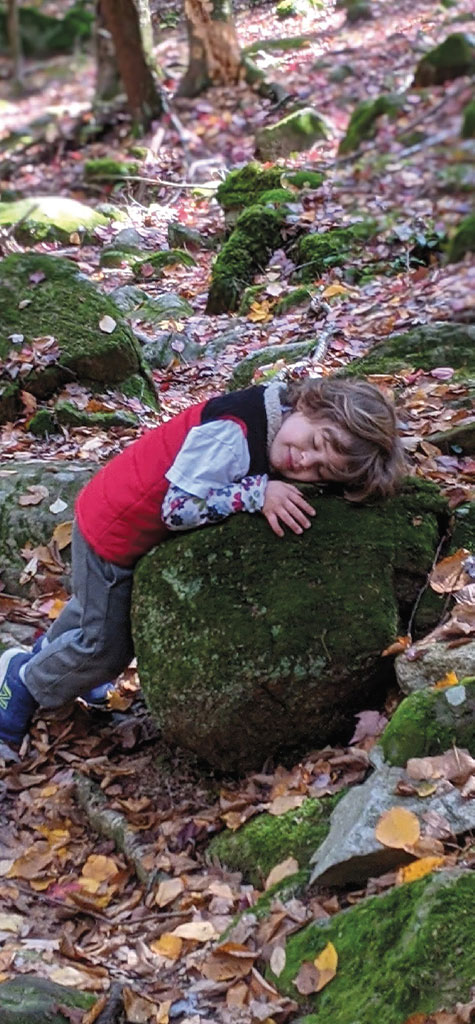
Kid in nature.
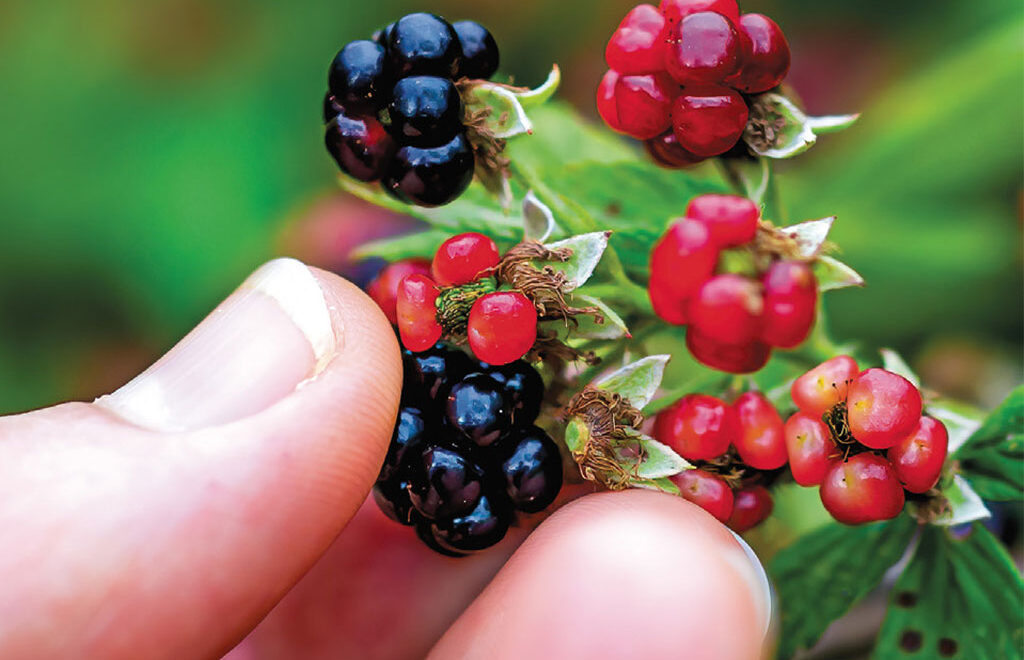
I retreat from the blackberry bramble to squint up at the treetops through beams of midsummer sun. There she is, a redshouldered hawk, calling from a towering pine. I cast a glance at my 11-month-old peacefully asleep in his stroller, the dog sitting at attention by his side. The hawk is telling us we’re too close to her nest. I push the stroller to another patch of prickly plants. The hawk hushes and the woods feel still again—save for the buzz of mosquitoes, the occasional squirrel, or songbird rustling nearby.
Harvesting blackberries has become my daily meditation after recently moving to an off-grid homestead in need of some TLC. In doing so, I aimed to significantly reduce my family’s reliance on the harmful consumer-based and industrial systems that run much of our modern world. A confluence of factors, including my remote job, a partner who knows how to build and fix things, and previous off-grid living experiences helped make this possible. While not everyone may have the opportunity—or the desire—to live this way, we felt it was right for us and for our child, who we hope will learn to treasure the Earth and understand that he is a literal part of it. However, it’s possible to raise an eco-conscious kid whether you’re living in the country, a city, or somewhere in between. The key is, wherever you are, to help your child foster a caring and respectful relationship with the Earth.
It’s no secret that kids (and adults) today are increasingly disconnected from the Earth and other living beings. A profusion of screens, endless cycles of consumerism, and social isolation fuel this trend. Some children have little or no access to safe outdoor spaces. According to the National Recreation and Parks Association, children today spend just four to seven minutes outdoors in unstructured play each day—compared to an average of seven and a half hours in front of screens. Today’s children can easily identify 1,000 corporate logos, yet many struggle to name just 10 animals and plants living in their own neighborhoods. And research shows that children who do not spend much time in nature suffer physically with increased risk of adverse health conditions such as asthma and obesity, as well as mentally, with slower development of communication and social skills, compared to kids who frequently go outside.
As I bend around another impossible tangle of vines, I remember how I weighed these realities when I decided to become a parent. After professionally documenting the plastic pollution and climate crises and other humanmade catastrophes for more than a decade, I’ve become hyper-conscious of humanity’s challenged relationship with the rest of nature, and indeed, with itself. Once you see the problems, it’s hard to look away. There’s plenty of data emphasizing the immense ecological costs of raising a child in hyper-consumptive nations like the U.S.: one study found that having one fewer child in the Global North slashes an individual’s carbon dioxide emissions by 58.6 metric tons per year, compared to the 2.4 metric tons of CO2 emissions saved annually by living without a vehicle. But statistics like this reveal a stark fact: It’s not having kids that’s the problem, it’s how we live with our kids that taxes the planet. If those of us who do choose to have children can manage to share both our love for the Earth and an ethic of planetary stewardship with our kids, then hope for a better future still remains.
Suddenly, I hear a scratch-scratch-scratch. I turn toward the stroller and see my son stretching; he’s waking up from his nap. We smile at each other, and I start picking closer to the edge of the bramble where he can see me clearly. He watches me fill the purple-stained pockets of my smock with huge, heavy berries that shine like onyx jewels. Sometimes the biggest, juiciest berries slip from my fingers and drop to the ground. These berries, I tell my son, we leave as gifts to the Earth; they will nourish insects and fungi, and turn into soil. And I remind him that we must leave some ripe blackberries to feed the bears, birds, and other creatures. We are forging a culture of care and gratitude for Earth and each other.
“If those of us who do choose to have children can manage to share both our love for the Earth and an ethic of planetary stewardship with our kids, then hope for a better future still remains.”
To raise an eco-conscious kid, I believe in spending time outside as a family, every single day. Each of us needs to feel grass, sand, soil, and water touch our skin; to place a hand on the bark of a tree, experience its solidness, its life. He may not understand fully now, but I will continue to teach our son to “be gentle with plants, as they are alive, like us” each time he tugs a fern frond from the ground. Our son is thrilled by touching smooth pebbles, crunching dried leaves in his fingers, and walking on soft grass; watching deer wander the orchard eating fallen apples, the hawk soar through the air. We encourage exploration and play, we are not afraid of dirt, and we don’t stress about minor scrapes and bruises.

Blackberry bramble.
While picking, I pull back the stroller’s mosquito net and hand my son a few of the smallest berries. He promptly squishes the berries in his hands and pops them in his mouth. As he chews, I describe how the berries will come back to nourish us year after year if we care for these woods we call home. He smiles at me with purple-smeared lips. He is learning where food comes from, what it looks like, how it grows.
By now my pockets are bulging with blackberries. It’s time to head back to the house to start dinner, some of which was grown in our garden, and the rest of which was bought at the grocery store. I acknowledge the reality of living in a modern consumer society where culture, advertising, and social pressures try to entice us to Buy, Buy, Buy — often, the newest and best of everything. It can feel hypocritical to buy gear to spend time in nature when inevitably that gear has some kind of deleterious impact on people and the planet— from the polyester in your hiking pack to the PFAS in your rain gear.
However, you can set an example by resisting the pressure to buy more and instead buy better, that is, do your research and take only what you need, what will last, and what you can afford. Opting for pre-loved gear instead of buying new—or making do with what you already have—has the least impact on people and the planet. This kind of conscious consumption can help teach your child that life is not about the brands or quantities of material things you possess, but the quality of the time you spend. Between our now-daily berry picking, and our usual jogs and walks, I estimate that we’ve put more than 2,000 miles on my son’s all-terrain stroller since he was born—equivalent to more than 1,000 hours together outdoors.
In today’s fast-paced, hyper-consumptive, high-tech world, it can feel more challenging than ever to raise eco-conscious kids. For example, while we’ve done much to eliminate synthetic substances from my son’s life, not every item he touches is completely plastic-free. While limited screen time has been linked to positive outcomes for kids, technological literacy is also critical for today’s youth. As more of us become aware of the urgent environmental crises we face, the pressure to do more as parents has never been higher (as any parenting social media feed will reveal). As we find ways to navigate, we must resist comparisons: Focus on doing what you can right now, not what others seemingly cannot.
What’s more, it’s important to understand that individual choices alone will not wholly solve the systemic problems we face. However, embodying the values we want to see reflected around us is a necessary step forward. Fully divorcing from mainstream consumer products and systems is unrealistic. Some use of fossil fuels and plastics, as well as visiting big-box stores due to lower costs, are a reality for most people, including my family.
“I remind him that we must leave some ripe blackberries to feed the bears, birds, and other creatures. We are forging a culture of care and gratitude for Earth and each other.”
Crossing the yard to the house, our dog gallops happily ahead of the stroller. I feel fortunate to have found our home here, the place my son will grow up. Smiling, I see a few last berries along the trail. To reach them, I gently ease my arm around a spider web to avoid tearing it, a reminder that our Earth and everything on it is connected by a single thread and must be cared for so the connections life depends upon do not break.
Erica Cirino is a writer and artist who explores the intersection of the human and more-than-human worlds. She serves as communications manager at the nonprofit Plastic Pollution Coalition and is best known for her widely published photojournalistic works, including her award-winning book, Thicker Than Water: The Quest for Solutions to the Plastic Crisis.