
Poetry as a Green Necklace
By Margaret Gibson
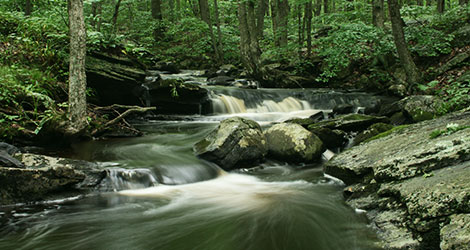
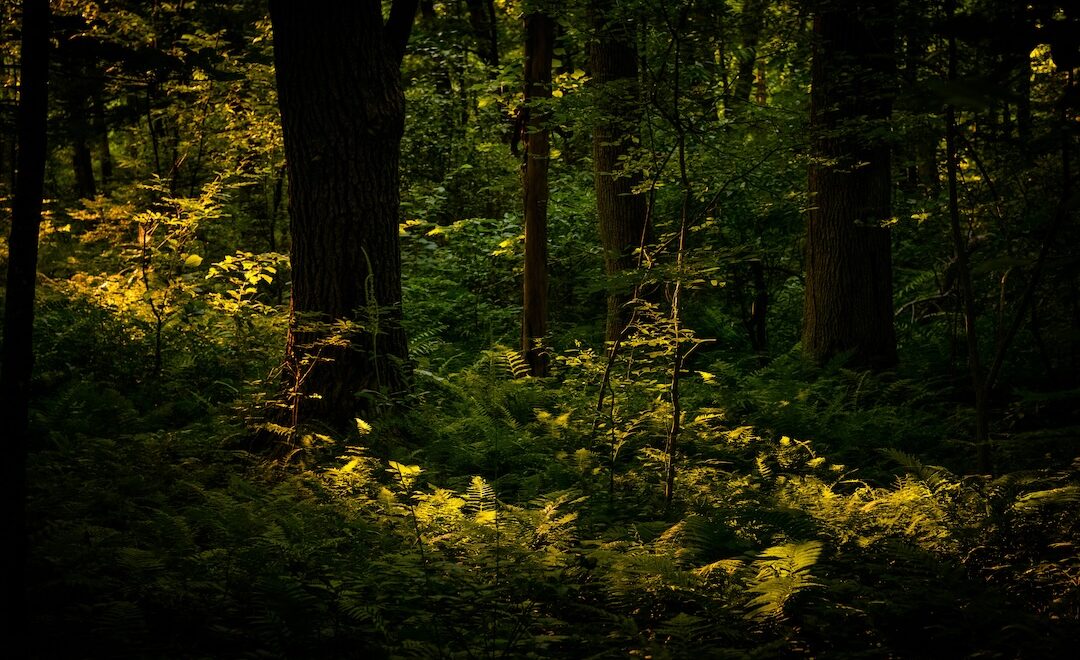
I live in a house in the woods. I live on seven acres, and these include the dirt and gravel lane which the town of Preston sold to the previous owner for one dollar. The physical boundary of the land extends to the surrounding woods owned by Avalonia Land Conservancy, about 200 adjoining acres in all—even more, if one includes the other nearby Avalonia land preserves arranged in a “green necklace” which I helped the Conservancy acquire and protect some years ago. A green necklace is a collection of connected small parcels of land.
It may not be surprising to learn that the Poetry Editor of Connecticut Woodlands lives in the woods herself. It has been my honor and my delight to ask other Connecticut poets to send me their poems about being in, being with, being of the natural world, in particular woodland habitat. The poems I’ve accepted in my six years as Poetry Editor also include other micro-environments—a garden, a door yard, a leaf-blown sidewalk—and for these, I’ve called on poets who may inhabit a more urban environment, but whom I know value our connection and our interdependence with other inhabitants of the natural world. I’m on the lookout for poems that diminish the sense of separation we humans foolishly impose between ourselves and the Earth itself.
I am lucky to live where I do, a guest of the woods and of the others who live here with me—the usual suspects: deer, coyote, owls, hawks (red tail and red shouldered), resident birds and seasonal migrants, an occasional bobcat, an infrequent mink at play in the watery margins of the pond, perhaps after tadpoles or frogs. The list is, of course, far more extensive, and it includes the black snake who winters in the old cellar of this small 17th century central chimney cape. I have a garden, a yard, a small meadow. Stone walls thread through woods that used to be farm fields. In this inhabited solitude, there’s enough room for us all.
Knowing where I am,
I know who I am.
By paying attention,
the boundaries of
my “self” keep moving.
Here, for over fifty years now, I have learned the names of trees, wildflowers, and birds, as well as to recognize an unseen bird by its song. “If you stay in a place long enough,” Annie Dillard wrote, “you’re bound to learn something.” I trust that counsel. I wait for the spring burst of pollen from the pines which border the far side of the pond, watch the black snake glistening in the corner of the patio after shedding its skin, wait to hear the barred owl’s call come through the night window along with the moon. Knowing where I am, I know who I am. By paying attention, the boundaries of my “self” keep moving. What I see and hear allows my narrow sense of self-boundary to increase and to include others. This is the work of mindfulness. Each singular and particular “other” becomes, very gradually, no other than myself.
To say it another way, all of us, humans and non-humans, inhabit this one body, this one life. We are, in ways often beyond our knowing, interwoven, interdependent, necessary to each other. The dragonfly that landed on the page of a poem I’d just begun quickly became the focus of the poem. The mourning cloak on the summer flower also does its own work. As a poet, my work is to “say it another way,” poem by poem, and each poem is a work of cross-pollination.
It has become clear to many of us that the failure to see the interdependence of all living things puts us all at risk. Climate crisis, climate emergency, extinctions, tipping points—scientists talk about these in one-way, environmental activists in another, spiritual practitioners another. How do poets “talk?” Poets speak and think in images, they get words and rhythm under the reader’s skin, they speak to the heart as well as to the mind of human beings, one by one. A poem is intimate, and intimacy can be very persuasive.
Language itself is intimate with the Earth. If you investigate the roots of words, you’ll find that many roots go deep into the Earth itself. Climate is rooted in the Greek word klima, meaning “the sloping surface of the earth.” Aubade, a poem to greet the new day, is traced back to the Spanish alba, or dawn. The verb investigate descends from the Latin vestigium, which contains in it the image of footprints imprinted on the earth. Words may be thought of as human “habitat,” but poets, whether writing about the natural, living world or not, write their poems by way of the Earth itself.
Poetry bridges the distance between language and Earth, language and breath, language and body, language and heart. Seeing oneself and the “other” by way of poetry helps us to see how closely connected we are with each other and with the living world. We ARE nature. Poetry is a record of that identity.”
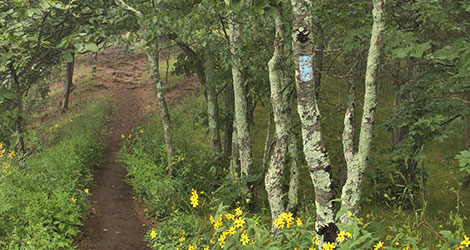
An ordinary necklace is an ornament, but an earthy green necklace is far from ordinary. In the world of land preservation, a green necklace may thread through human settlements, creating corridors for wildlife, offering them a way to connect to habitats they depend on—woods, fields, watersheds. Poetry is, likewise, not an ornament. Its value is aesthetic, but as the most intense and intimate form of human speech, poetry is also a form of connection. As a green necklace, poetry reminds me of a Hindu metaphor for the cosmos—the jeweled net of Indra, whose single threads meet and join at junctures, and where they do, at that point of connection, there is a jewel. The net shimmers with jewels. I like to think of the words in a poem that way—as points of connectivity and light that say who we are and where and how we live on this Earth.
Margaret Gibson is the poetry editor of Connecticut Woodlands.