


Not Just a Fish Story
When it comes to endangered species, good news can be hard to come by. So, when a biologist uses the word “recovery,” he does not do so lightly, particularly when describing a historically abundant fish species that vanished from the Connecticut River decades ago but has recently shown signs of a comeback.
By Laurie D. Morrissey | Photographs by Jake Snyder
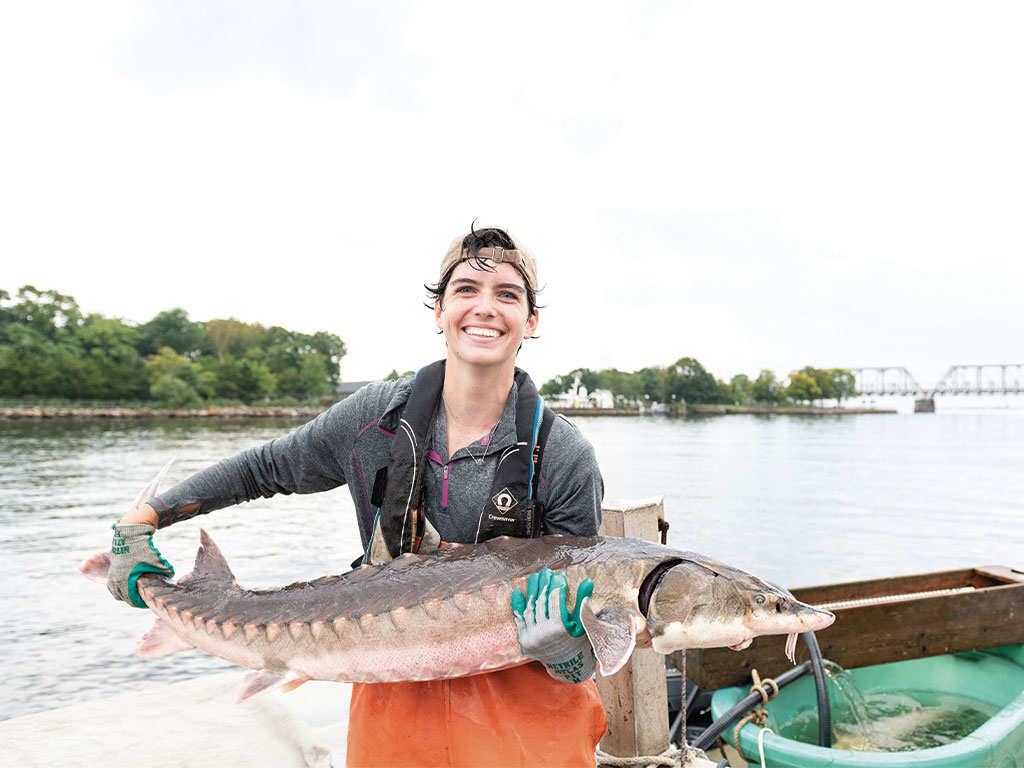
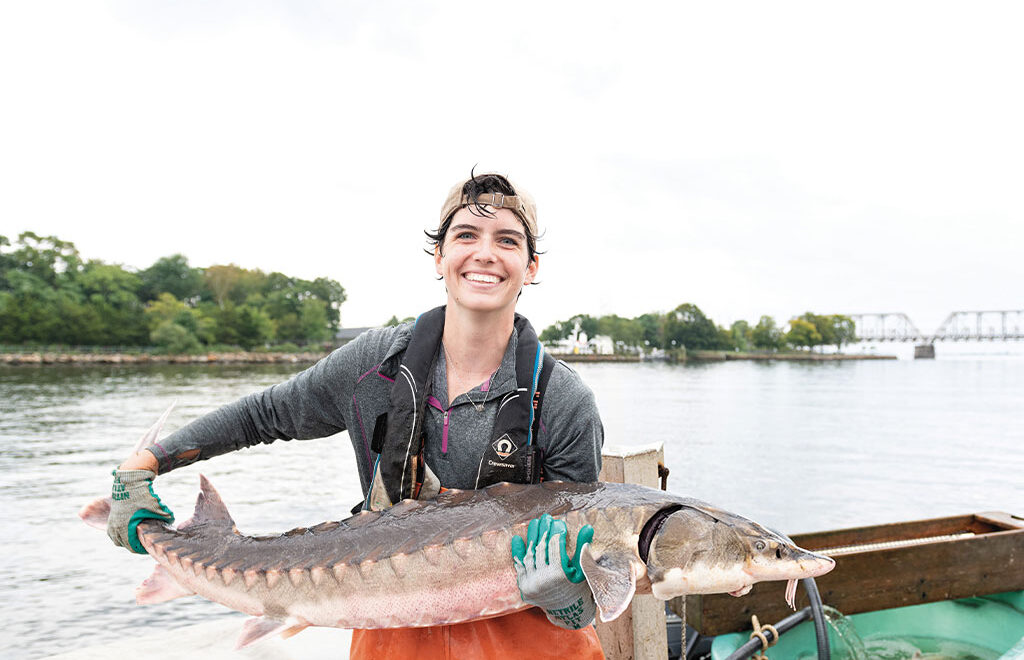
Biologist Kelly Mosca holds a large Atlantic sturgeon before releasing it back into the Connecticut River.
The Atlantic sturgeon (Acipenser oxyrinchus) is one of the largest and longest-lived anadromous fish in North America, with a fossil record dating back 160 to 200 million years. These giant fish were swimming around when Tyrannosaurus rex roamed the Earth, and their appearance has not changed in all that time. They are heavy-bodied, stretching 14 feet and weighing up to 800 pounds, with a long, pointy snout, a shark-like tail, and rows of hooked plates instead of scales. Beneath the snout are four dangling protrusions, or barbels, used to help detect food on the murky sea floor.
Anadromous fish are born in fresh water, migrate to the ocean, and return to fresh water as adults to spawn. Atlantic sturgeon, striped bass, Atlantic salmon, river herring (alewife and blueback herring), and American shad all are anadromous species found in the state. Of more than 20 sturgeon species found worldwide, two are Connecticut natives: shortnose and Atlantic.
For many people, the sturgeon’s biggest claim to fame is as a source of caviar. But for scientists, the fish is an essential part of both freshwater and estuarine ecosystems, and for that reason alone, very much worth protecting.
Hannes Baumann, a fisheries ecologist at the UConn’s Department of Marine Sciences, is working to save the Atlantic sturgeon, an iconic fish often called “a living fossil.”
“You have a species that evolved before the age of the dinosaurs and survived through unbelievable changes in the Earth’s crust, environment, and climate,” he says. “For humans to be the nail in their coffin would be unbelievably sad.”
Atlantic sturgeon once were bountiful along the Eastern seaboard from Labrador to Florida, spawning in the larger rivers along the coast. The Connecticut, Thames, and Housatonic all had spawning populations. Indigenous people harvested the fish for meat and eggs for thousands of years, and Europeans relied on them when they arrived on North American shores. (“More than could be devoured by dog or man,” wrote Captain John Smith—and the two sturgeon species have been credited with saving the Jamestown Colony settlers from starvation.)
During the early 19th Century, the pursuit of caviar riches became known as the Black Gold Rush. There was even a use for their sturgeon bladders in manufacturing glass, waterproofing agents, adhesives, and lubricants. The result was a drastic decline in population. According to the National Oceanic and Atmospheric Agency, close to seven million pounds of sturgeon were caught in 1887 alone.
More recently, the population has suffered from dam building, habitat loss, and continued overfishing, including accidental by-catch. The harvest dropped to 20,000 pounds by 1905 and to 400 pounds by 1989. Both Atlantic and shortnose species are now protected. In 1998, the Atlantic States Marine Fisheries Commission issued a coastwide moratorium on commercial fishing, and the only specimens legally caught today are taken for research and management purposes.
Since the Atlantic sturgeon was listed under the Endangered Species Act in 2012, the population has increased. The caveat, Baumann points out, is that the fish is late-maturing and does not spawn every year, so gauging the results will take time. Atlantic sturgeons are sexually mature at around age 12 and the females produce eggs only every two to six years. Their reproductive health may suffer from the effects of chemical pollutants such as PCBs, accumulated over the fish’s long life.
“Any efforts of protection now will take a long time to make the population more robust,” Baumann says.
Biologists in Connecticut began monitoring shortnose sturgeon in the late 1980s, collecting fish with skiff trawls and gillnets and attaching visual tags to their dorsal fins. The occasional Atlantic sturgeon the researchers caught were believed to be visitors from the Hudson River that swam around Long Island, rather than fish that entered the Connecticut River to spawn.
In May of 2014, there was a banner event for sturgeon scientists. A team of DEEP researchers, including fisheries biologist Tom Savoy, was motoring slowly up the mouth of the Connecticut River when they pulled up a net containing an Atlantic sturgeon hatchling. It was a stunning discovery, indicating that the species could be rediscovering the river as a spawning ground.
In 2019, Baumann began a collaboration with Savoy and DEEP. They caught tiny Atlantic sturgeons in 2017, 2022, and 2025. Each fish they catch is weighed and measured, and tissue samples are taken from some specimens before being returned to the river. The researchers gather data on age, condition, and migration patterns. In some individuals, they surgically implant ultrasonic acoustic transmitters to track the fishes’ movements. Ultimately, the findings may help inform plans that protect the sturgeon’s habitat and rebuild their population, although probably not to historic levels.
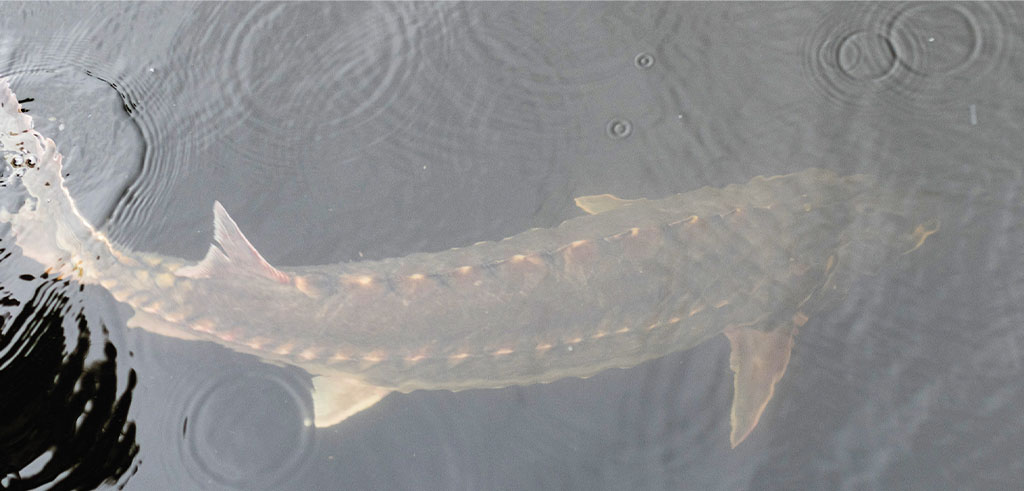
Sturgeon swimming.
“You have a species that evolved before the age of the dinosaurs.”
Researchers are cautious about the prospect of recovery. “We’re not sure if Atlantic Sturgeon are recovering well enough to survive,” Savoy admits. “The 2014 catches were certainly exciting and unexpected, although we had been looking for young-of-the-year sturgeon for decades. Having the genetics tested and documenting that they were the result of spawning in the Connecticut River and not from having swum in from another river was even better. Locally, we have seen some signs of increased abundance. The presence of small, young fish is certainly encouraging.”
Baumann directs UConn’s Evolutionary Fish Ecology Lab, where he and his colleagues investigate coastal fishes with the goal of better understanding the ongoing changes in local fish communities and how they may be able to cope with ocean warming and other environmental factors. He’s cautiously optimistic.
“We found a handful of individuals that were born in the river. If they survive 12 years, hopefully they’ll return to their natal river to breed,” he says. “With such a low level of abundance, it’s very hard for an adult to find another. But it’s reasonable to assume it will happen in the next decade or two. We have yet to see a female with eggs, which would be a better and more definitive proof that they’re using the river as spawning grounds.”
Baumann believes that nature has an amazing capacity to restore itself, but it needs our help. If you spot an Atlantic sturgeon—whether it’s breaching, accidentally caught, or washed up on shore—contact DEEP. You can help give a new lease on life to a species that’s and just possibly keep a living fossil alive.
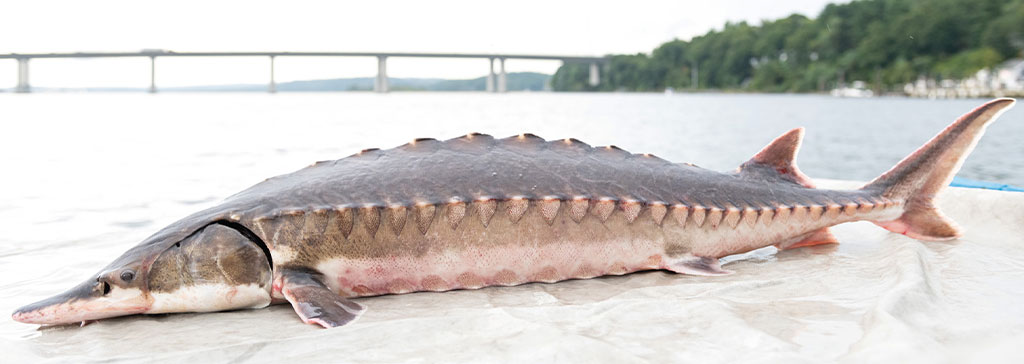
Sturgeon out of water.
Laurie D. Morrissey is a New Hampshire-based writer whose work has appeared in Connecticut Woodlands since 2016. She has also been published in Northern Woodlands, Art New England, New Hampshire Home, Appalachia, and numerous poetry journals.