

New Haven Youth are Planting Resiliency
At UrbanScapes Native Plant Nursery, young people are learning to nurture and grow.
Words and Photos by Briget Ganske
On a rainy Saturday morning in May, eighteen-year-old Tyshaun Lester was helping a customer find a purple coneflower. It was his favorite plant at Urbanscapes Native Plant Nursery—once a vacant lot in the Newhallville neighborhood of New Haven, now filled with a greenhouse, pavilions, and hundreds of potted plants for sale. “I love the coneflower because of the color,” Lester said. “It can be either yellow or purple. I like it because it’s also a tall plant.”
Lester has grown taller himself in the last six years working at the nursery. He was in middle school when his mother introduced him to Doreen Abubakar, the founder and executive director of Community Placemaking Engagement Network (CPEN). CPEN has been transforming Lester’s neighborhood, Newhallville, which sits only a few blocks but a world away from Yale University. Thanks to CPEN, the former crime hotspot nicknamed “The Mudhole” is now The Learning Corridor, a park with benches, water fountains, a butterfly garden, and bike repair stations.
Dennis Riordan, president of the Menunkatuck Audubon Society, has worked with Abubakar since 2011 when he first started helping with her West River Water Festival. After years of programming and building native pollinator habitats around the city, in 2019 Riordan suggested to Abubakar that they start growing native plants. “What do you think of starting a nursery?” Abubakar remembered Riordan asking her. She had her eye on a vacant lot in Newhallville, on the corner of Hazel St and Shelton Ave, right near the Learning Corridor. Many places build community gardens in vacant lots, Abubakar explained, “but I wanted to do something that would be more of an engagement piece in the Newhallville neighborhood because they don’t have a library or a medical institution. They don’t have stores, only bodegas. And so I wanted to do activities in the vacant lot.”
CPEN leased the lot from the city, and in 2020—shortly before the pandemic began—partnered with Menunkatuck Audubon Society to start Urbanscapes, a native plant nursery and youth training program. Now the lot also holds a greenhouse, beehives, pavilions, a makerspace, and a Trailside Cafe in-the-making—all opportunities for locals, especially local youth, to participate.
Abubakar grew up in New Haven, in the Dixwell and The Hill neighborhoods. Her journey to become an urban environmentalist began when she was a teenager, on a camping trip where she canoed down the Connecticut River. “It was there that I had the opportunity to really see nature in a different way,” she said. “When you’re on the water, you’re seeing nature from a different view than the concrete that we constantly see in the city. And I felt like, wow, look at this. And so that’s what really started my venture to focus on how do we connect minorities and our underserved neighborhoods to the nature that’s right here in the urban city?”
“We use the plants to build self-esteem,
confidence, and the ability to communicate.
The goal wasn’t that they would go to school for
this stuff. The goal was that nature conservation
would not be foreign to them, personally.”
-Doreen Abubakar
At Urbanscapes Native Plant Nursery, New Haven youth work with Abubakar and Riordan to learn about and take care of native plants. Why native? “The native plants and the native wildlife have evolved together,” Riordan explained. “Cultivars are often grown so that they’re more beautiful than functional for wildlife. So in order to support bees, butterflies, birds, and other wildlife, you need native plants that they can make use of.”
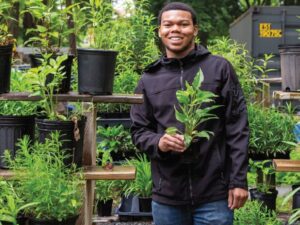
Tyshaun Lester has spent six years working at Urbanscapes Native Plant Nursery.
A native plant is one that has occurred naturally for thousands of years in a region. Only plants found in this country before European settlement are considered to be native to the United States.
Examples of plants native to New England are the red maples, black-eyed susans, and common milkweed. Non-native plants, by contrast, are species that have been introduced from other regions of the country or from around the world. Invasive plants are non-native and cause environmental harm by rapidly outcompeting native species for essential resources, reducing biodiversity, and depleting vital water supplies. In New England, it is estimated that non-native plant species make up about a third of the flora, and 10 percent of these qualify as invasive.
Cultivars, as Riordan mentioned, are plants that people have selectively bred for specific characteristics. Cultivars can be derived from non-native or native plants (native cultivars are called nativars). Breeding plants for aesthetics alters the gene pool, flower shape, bloom time, and fragrances, causing susceptibility to disease and preventing birds and insects from accessing nectar and pollen.
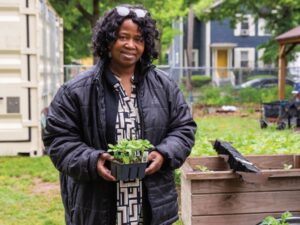
Doreen Abubakar is the founder and executive director of Community Placemaking Engagement Network (CPEN).
For example, the butterfly bush was introduced to the United States from China in the early 1900s. A nonnative cultivar, butterfly bush is highly invasive in New England. “It’s a plant that is sold in a lot of nurseries and it’s a beautiful plant,” Riordan explained. “In summer, it’ll be covered with butterflies getting nectar, but that’s all they can do. Other insects can’t make use of it.” By monopolizing pollinators with massive amounts of nectar, butterfly bushes distract insects away from flowering native plants. This makes it harder for the native plants to reproduce, drastically reducing the food supply, like caterpillars, needed for nesting birds. A better option? “Butterfly weed, which is a type of milkweed, is very important for monarch butterflies,” Riordan said. In fact, monarch butterfly caterpillars eat only milkweed. “No milkweed, no monarch butterflies.”
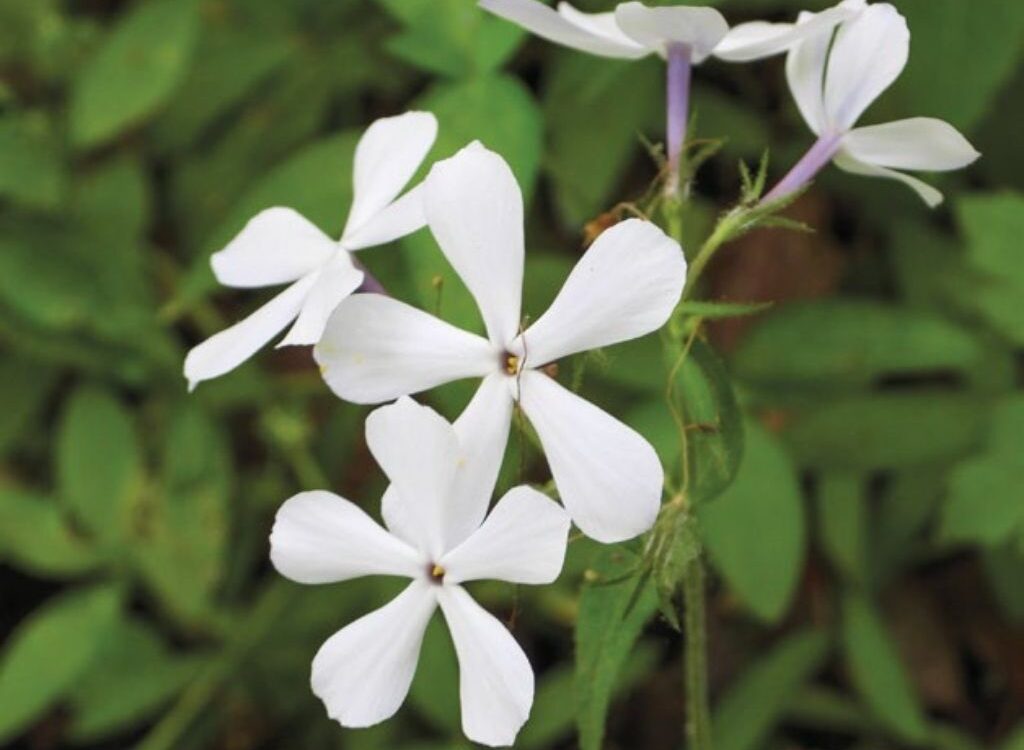
Woodland phlox (Phlox divaricata)
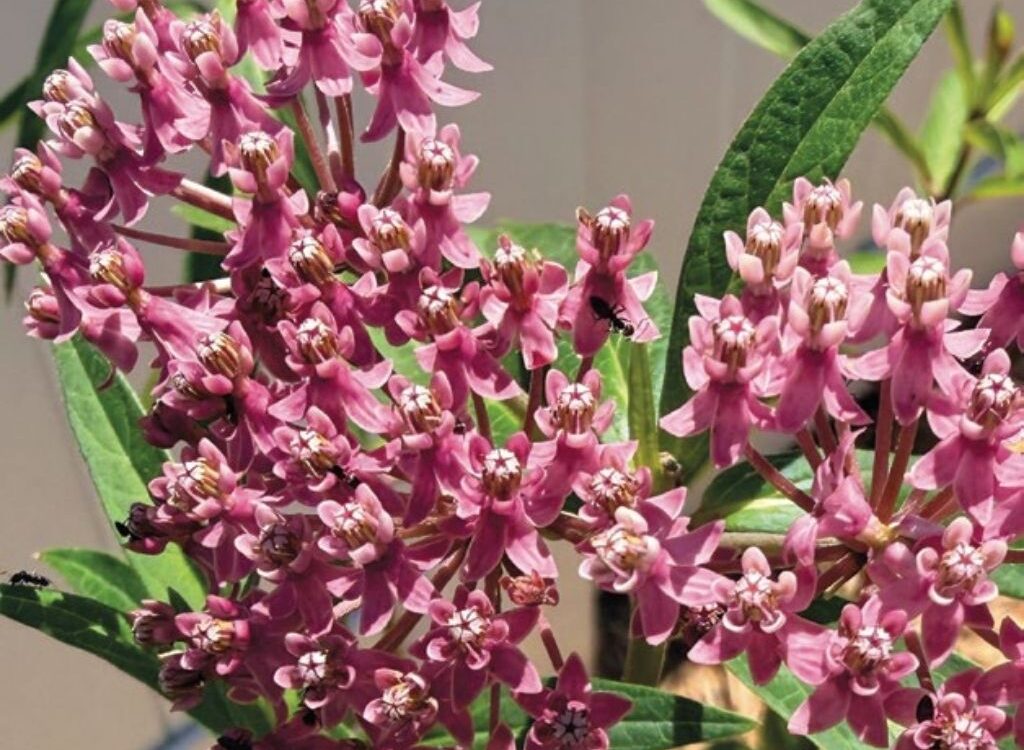
Swamp Milkweed (Asclepias incarnata)
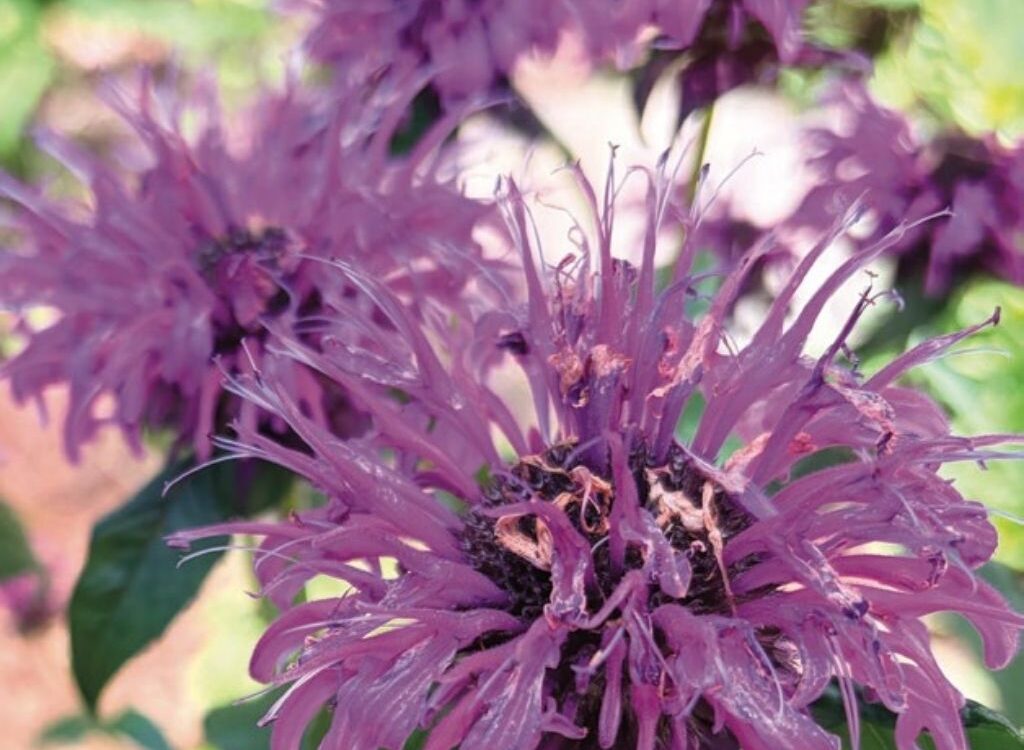
Bee Balm (Monarda fistulosa)
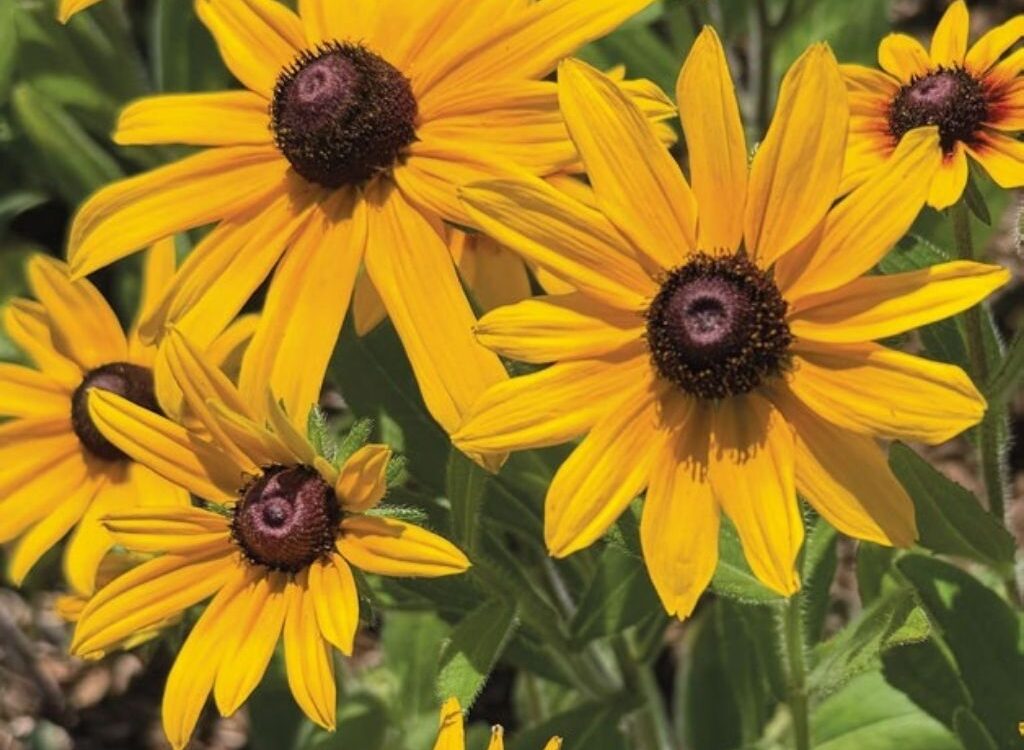
Black eyed-susan (Rudbeckia hirta)
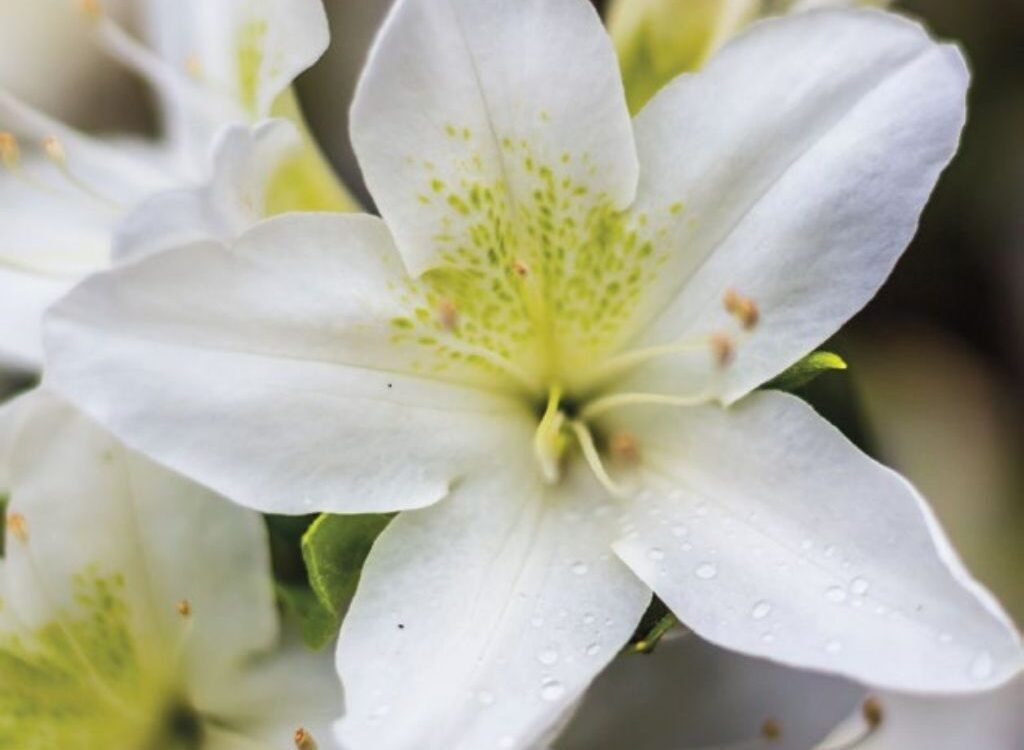
Swamp Azalea (Rhodedendron viscosum)
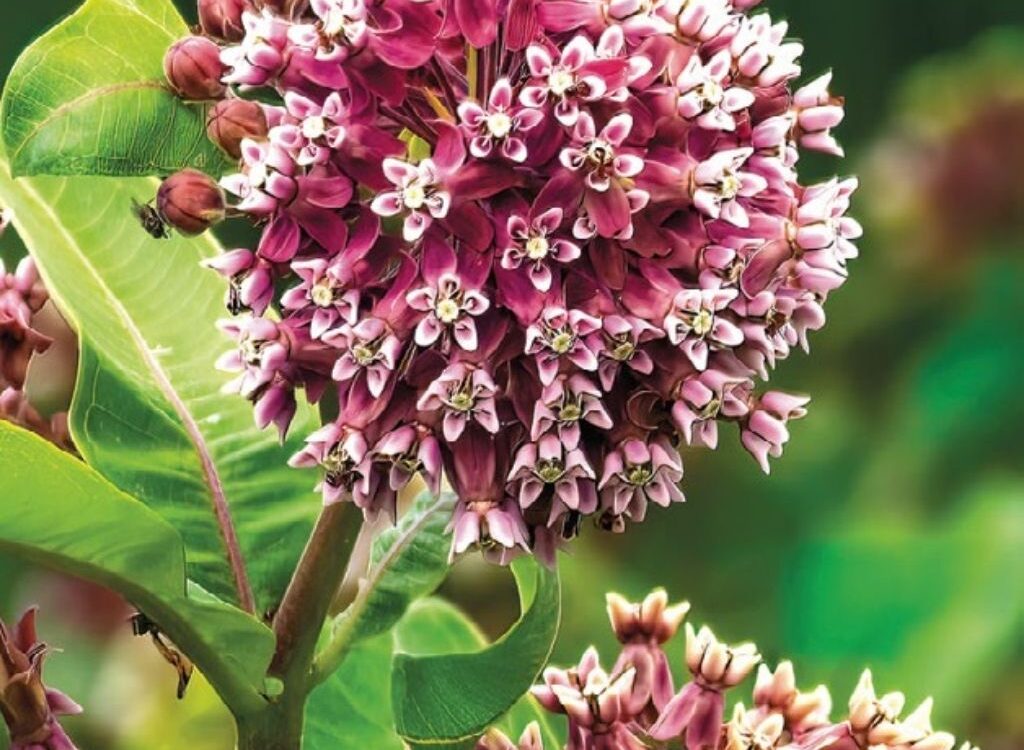
Common milkweed (Asclepias syriaca L.)
Urbanscapes’ outdoor wooden shelves hold pots of milkweed, goldenrod, beebalm, and golden alexanders. The nursery grows between 4000-5000 native plants a year, from shrubs and trees to perennials and vines. “You can get native plants in other nurseries,” Riordan said, “but you got to sort through the cultivars and nativars and ornamental plants and all that. We’ve got straight native—everything is straight native.”
Young people begin working in the early spring to pot starter plants in plugs then tend the plants through the growing and selling season. Besides helping with a community clean up once, Lester hadn’t worked with plants before beginning the training program at Urbanscapes. Abubakar first taught him how to repot plants. Now Lester and the plants have a special relationship. “I like how they have their own self,” he said. “Meaning, it feels like you’re talking to a person. Because I feel like plants do have feelings as well.”
Lester and a fellow worker, Randall Flemming—who also lives in Newhallville and has been with Urbanscapes since its first year—helped two women carry plants to their car. Despite the rain picking up, everyone seemed in good spirits. The table under the pop-up tent was full of snacks. Other youth worked in the greenhouse repotting and watering plants.
The nursery grows between
4000-5000 native plants a year, from
shrubs and trees to perennials and vines.
“We use the plants to build self-esteem, confidence, and the ability to communicate,” Abubakar said. “The goal wasn’t that they would go to school for this stuff. The goal was that nature conservation would not be foreign to them, personally.”
Each spring, the nursery provides work stipends for four to six young people, many of whom come back year after year. “The most rewarding part of my job is coming together as a community,” Lester said. “We have formed, like, a brotherhood.” Lester graduated last spring from Eli Whitney Technical High School. For a while, he planned to start a plumbing business straight out of high school. “We encouraged him to go to college,” Abubakar said, “so he’s getting a degree in business, and hopefully then he’ll know all the ins and outs of running a very successful plumbing business.” Lester finished his first year at Central Connecticut State University (CCSU) and he credits CPEN and Urbanscapes for who he has become. “It’s helping me by growing into a young man,” he said. “Miss Doreen was giving me lessons throughout time. I felt like that really helped me. And I really see my growth building with the nursery.”