Hiking Indigenous Lands
Jay Levy is working to educate people about Indigenous sites along the NET, and to remind hikers who’s land they’re on.
By Timothy Brown
Jay Levy is an archaeologist with the Mohegan Tribe who’s worked extensively with CFPA and other organizations as a cultural advisor and liaison, integrating Indigenous ideology, tribal tradition, and cultural protocol into land conservation. He’s currently writing an Indigenous guidebook for the New England National Scenic Trail, or NET, scheduled to be published next year by Connecticut-based FalconGuides. The book builds on his previous work to identify and map Indigenous cultural sites along the 235-mile trail, which is co-managed by CFPA, the National Park Service (NPS), and the Appalachian Mountain Club (AMC).
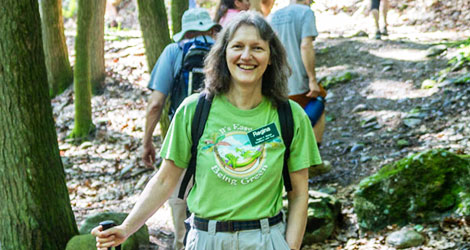
Earlier this fall, I met Levy for a hike at Sleeping Giant State Park— where the giant, Hobbomock (pictured above), rests peacefully—to learn more about his project and the Indigenous history of this land.
This interview has been edited for length and clarity. ➾
CW: The NET doesn’t pass through Sleeping Giant. Why was it important for you to include Hobbomock in the book?
JL: The focus is on the Indigenous history of the NET and Hobbomock is just such a huge part of the Connecticut River Valley, and he keeps popping up where he’s left a mark on the NET. He’s got a pretty significant role in shaping the landscape—not just forming the hills and the valleys— but as a cultural hero to the people, and not just for Quinnipiac people. He taught us a lot—he was teaching people how to care for the Earth. We’ve lost a lot since colonization.
CW: How did this book project begin?
JL: I used to work for Appalachian Trail Conservancy as an Indigenous Partnership and Research Coordinator where I developed a territorial map of the Appalachian Trail. I was a CFPA Trail Manager for the Narragansett Trail at the time, and they heard about that work. They received a grant from NPS and asked me if I would do an (Indigenous) site survey of the NET. I did it, and (then) NPS and AMC contacted me to continue the project going into Massachusetts to the northern terminus, so I did that. I was kind of reestablishing those places, reestablishing those traditional routes—up these mountains and down them, reestablishing the connection to the land, not just for Tribal folk but for the public. I loved that project, walking these areas, finding out who’s land I am on.
CW: Most people I know would never consider the question of whose land you’re on.
JL: It’s so natural for me. Not just in the woods—out there, too. When I’m going down to Dunkin’ Donuts to get a coffee, I wonder, Whose land am I on? Those were once important sites. Still are. A lot of the old Indian trails are now roads, and they lead to those places.
I don’t see a strong definitive line between nature and the concrete world. I see a decline in the woods, slowly turning into that concrete world; the lack of respect; the invasive species coming in to choke out the native plants. My eyes are here just as they are out in the concrete world.
“We can’t understand fully or respect each other without knowing all our histories.”
CW: How did you decide which Indigenous sites to include?
JL: Talking and walking with elders, sitting with them, building up those relationships. Then going to those sites. I had to pick sites that were not culturally sensitive, ones that were fairly easy to hike to, and tell the story about the Indigenous continuance, presence, stewardship of those lands. There’s no Indian reservation along the NET, but it’s all ancestral territory.
CW: Who is this guidebook for?
JL: The book is for both Indigenous and non-Indigenous readers. I’m trying to record these stories for everybody. We all need to take care of the Earth. It just can’t be the Tribal kids; we need everyone on board for our species to survive. And for non-Indigenous people to say, “I read this in an Indigenous guidebook, and we need to protect this,” that’s good. But I could also use it as a tool for cultural education for tribal youth. When I bring them on hikes, I’ll give them the book and say, “If you want to go on another hike, call me up! Or go ask your grandparent about these places.”
CW: Why is it so important to use original place names?
JL: Early Puritans and colonists saw us gather at tallis slopes, or glacial erratics, or a waterfall. We’d gather there not just because it was a good fishing spot, but to share these teachings. And they would see us gather and would conveniently rename it Devil’s Garden, or Devil’s Hopyard, or Satan’s Kingdom to demonize the Native people and put them into a view of deep devilishness or evil. So, there are talks about renaming them to their original names, renaming and reclaiming these places. Erase that part of history, erase Hobbomock. They are teachers; they’re our Elders.
CW: Historically Indigenous people didn’t own this land. Did they share it?
JL: It definitely was shared; a lot of people don’t know that. And that’s the difficulty I had in creating Indigenous maps—you’re making these maps with lines. I started using dots, and that wasn’t working. Then I started using a fade-in-and-out. But (territories) were intertwined, braided. You had your village, and outside were the planting grounds, and outside the planting grounds were all the hunting grounds, and all those hunting grounds were shared. Today we still come together intertribally, socially, ceremonially.
“I don’t see a strong definitive line between nature and the concrete world. I see a decline in the woods, slowly turning into that concrete world.”
CW: Why is reciprocity with the land so important?
JL: I think there’s a universal understanding of taking care of the land because she takes care of us. So why would we harm her? Why would we continue to take from her without giving back? Even giving thanks is a way to give back. As Indigenous people we give back. When I go into the woods, I leave a little offering like tobacco, or a saying of thanks. It’s not good to be constantly taking, taking, taking.
CW: When you talk about “the land,” are you talking about more than just what we’re walking on, like the plants and animals as well.
JL: Animals are our kin. They’re our brother and sister; they’re that close to us. They’re not just an object or something to walk on, they are relatives. That rock and that plant and that tree have a relationship and we’re part of that as well. And a lot of us choose to harm—or don’t acknowledge— that relationship. We all could have that connection to the land. It just depends on what you want and what the purpose of your life is.
CW: Is it difficult to navigate both Indigenous and Western worldviews?
JL: We say we’ve got one foot in the canoe and one foot out. You’re always trying to balance it. If you have a strong upbringing in the culture, it’s easier, but even one moment with an Elder can change a child who’s not been brought up in the culture.
CW: Historically, did Indigenous people do trail maintenance?
JL: Not trail maintenance like we do today, but there were landmarks that guided you through the forest, (like) stone piles or cairns; some say that bent trees were also. A lot of times natural landmarks, like a large glacial erratic, indicated where you go down a ravine to find water, or something like that. A lot has been lost in terms of petroglyphs or maps carved into stone, but those were used to navigate. Tribes also actively managed the land—limiting hunting, burning to clear underbrush, clearing forest to create game habitats, and the keeping the forest healthy. Today (management) is still done but also includes dam removal and bringing the language back to the land.
CW: Throughout our hike, I keep thinking about the word “relationship.” Obviously, there’s history and culture in your book, but you’re also helping to reestablish relationships.
JL: Not just history. That’s important, but I’m trying to get beyond that, which is hard to put into a book. It all started going downhill with the Invasion. I keep calling it that because not only was it an invasion of people and different cultures, but also what they’re bringing with them, all the non-native species. And I see it in the plants. They’re being choked out, literally, like we were choked out. And I see them suffer, and I see they’re not producing as many berries.
These lands, we all share now. It’s all part of our history and we can’t understand fully or respect each other without knowing all our histories. That’s what I’m trying to do with this book—to bring out an Indigenous perspective of where we’re hiking.
Timothy Brown is the editor of Connecticut Woodlands.