

Giving a Face to Forgotten Creatures
Artist Sam Swap uses printmaking to connect people to nature and the New England Trail.
By Timothy Brown
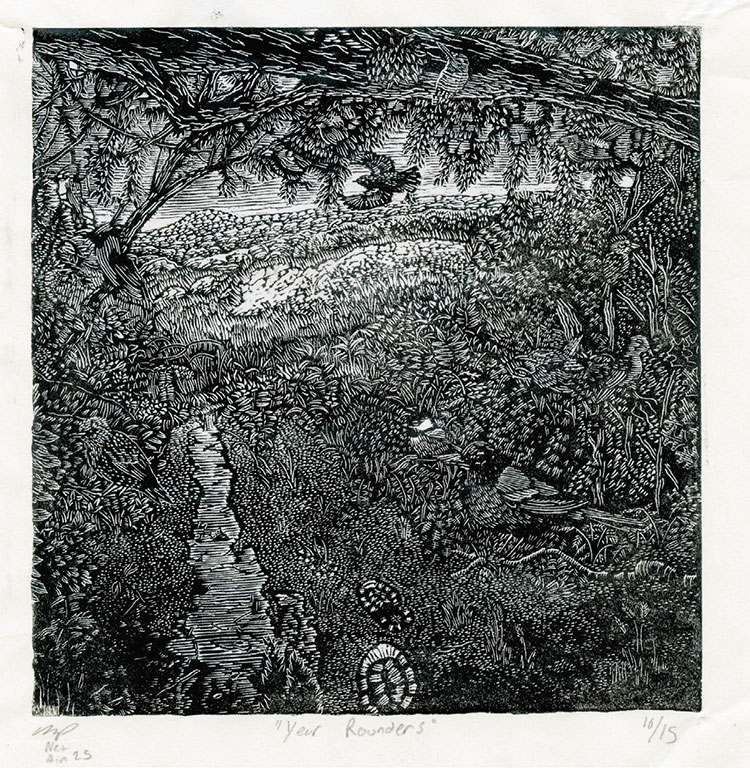
Black and white artwork by Sam Swap.

Artist Sam Swap holds an engraved wood block ready for printing.
It’s a warm, mid-September afternoon as I climb the steep, rocky trail to Bluff Head in Guilford to meet Sam Swap, an illustrator, printmaker, and educator—who also started his own publishing company, Third Cat Press. Swap is the 2025 New England National Scenic Trail, or NET, Artist-in-Residence. Since 2012, CFPA and the National Park Service have sponsored the residency, connecting people to the trail through art and education.
I arrive at the bluff sweaty and out of breath. I find Swap calmly perched high on the bluff’s edge as a hawk soars overhead. He holds in his left hand a small wooden block. In his right, a sharp engraving tool called a spitsticker. He makes small strokes into the block, removing bits of the tightly grained wood. Later, he’ll use the engraving to create an original print that blends the physical world with the imaginary.
“In a world saturated with digital creatives and the growing presence of generative AI, Swap’s work feels uniquely tangible.”

Ink is rolled onto wood block in preparation of printing.
Swap’s love of Connecticut landscape was cultivated growing up on a pond in Ivoryton. In addition to hiking and biking with his family, he attended and later worked as a counselor at the Bushy Hill Nature Center camp. And like many other kids, he dreamed of one day becoming a photographer for National Geographic. But as an undergraduate at the Hartford Art School, he discovered a passion for illustration. “I found it to be a lot more engaging than photography,” he said, “I have this background in nature education—and I have this love of communicating about nature through art—so I figured I could just start making my own children’s books based around nature.”
After graduating, he landed a job as an artist’s assistant at the Florence Griswold Museum in Old Lyme where he discovered the artwork of Thomas Nason, a wood engraver best known for creating detailed prints to accompany the published poems of Robert Frost. Swap was inspired both by Nason’s work and the Old Lyme Arts Colony—an early 20th century collective that produced some of America’s greatest Impressionists—of which he was a member.
“One thing I especially love about Connecticut artists and Impressionists is that it was a stylized view of nature, like a lot of old English block prints or Japanese-style printmaking. They were abstracting nature to kind of anthropomorphize it, like frogs in dresses dancing around,” he said. “I don’t want to do an exact representation of the world because then I could just take my camera. I like adding my own little stylistic flair to it.”
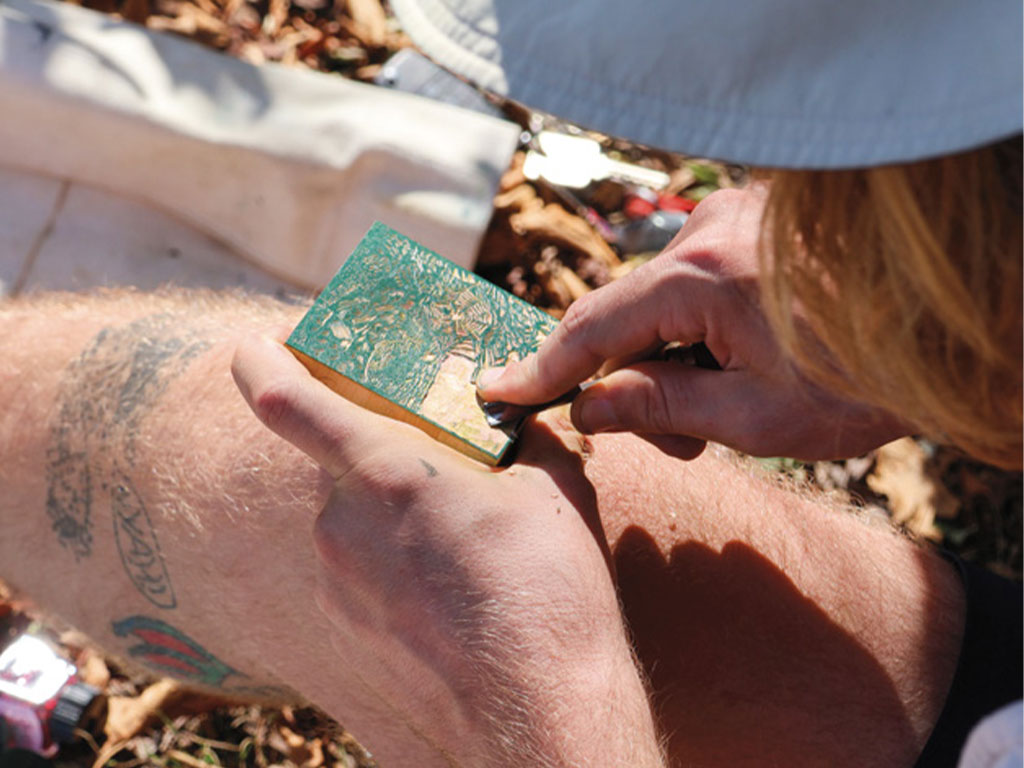
Artist Sam Swap engraving a design.
“I really studied what I was doing and pieced it together bit by bit. Each mistake helps you to become a better artist.”

Completed print in frame.
Swap’s prints are full of intricate details, like other traditional wood engravings and such contemporary illustrators as Maurice Sendak and Bill Watterson of Calvin and Hobbes fame. “I was obsessed with how masterful these illustrators were, while also being really good at communicating these stories,” he said. “And it just felt like a really good avenue to push myself with a physical medium.”
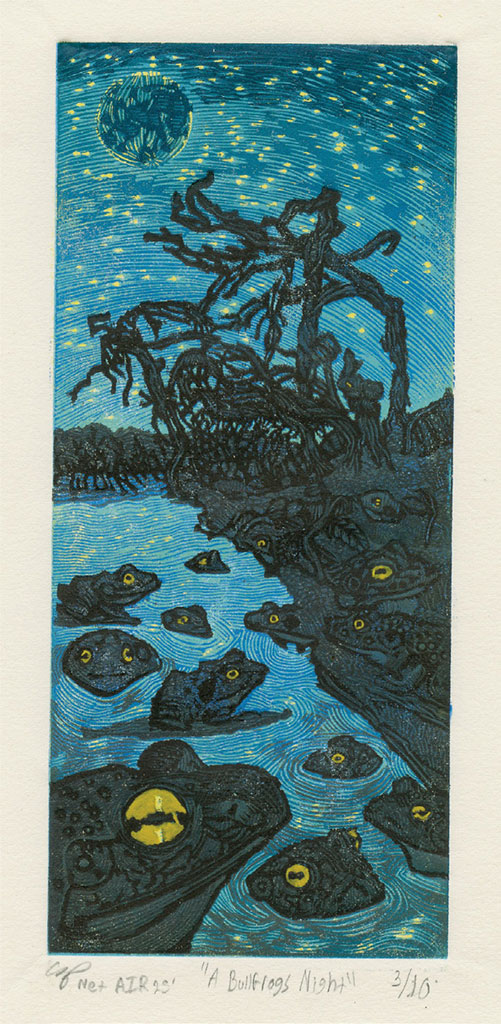
“A Bullfrogs Night” print by Sam Swap.
Also, like many of the Old Lyme artists, Swap was inspired to create works of art outdoors—“en plein air”—surrounded by the natural elements, rather than inside a traditional art studio. It’s an approach he has honed throughout his residency, creating a series of prints of the animals that call the trail ‘home.’
His is a relatively simple set-up: small maple blocks weighing just one-sixteenth of a pound; an assortment of engraving tools; vegetable-based relief ink (he only carries primary colors into the field); a small wooden frame; and paper for printing. As he carves, a detailed image gradually appears. When he’s done engraving, he applies the sticky ink, which is mixed with a wax drier to hasten the drying time. He then sets the block in the frame to make multiple, nearly identical prints. It’s a system he has perfected throughout the residency, although he admits there’s been a bit of a learning curve. “The first time I went out to Chittenden Park and did this little print, I completely messed it up,” he said. “But then I really studied what I was doing and pieced it together bit by bit. Each mistake helps you to become a better artist.”
Hikers pause to chat with Swap, intrigued not only about his creative process, but also the residency. “In America, people think from a very capitalist perspective, like if you’re not making money from the art, then what are you doing? I’m getting people to celebrate the trail,” he said.
He also chats with passers-by about the natural world. His subjects tend to be small, oft-overlooked creatures with complicated reputations, like grackles, which happen to be his favorite bird. Swap sees himself not only as an artistic ambassador, but as a voice for nature as well. He wants people—especially kids—to understand that all species are important, not just the big, famous, furry ones, and that there are countless creatures that often go unseen—such as pollinators or invertebrates—that are critical to healthy, functioning ecosystems. It’s a theme woven throughout all his work.
“I love that I can get people on that wavelength with these prints or the books that I write. I just want to give a face to the species in nature that we tend to forget about,” he said.
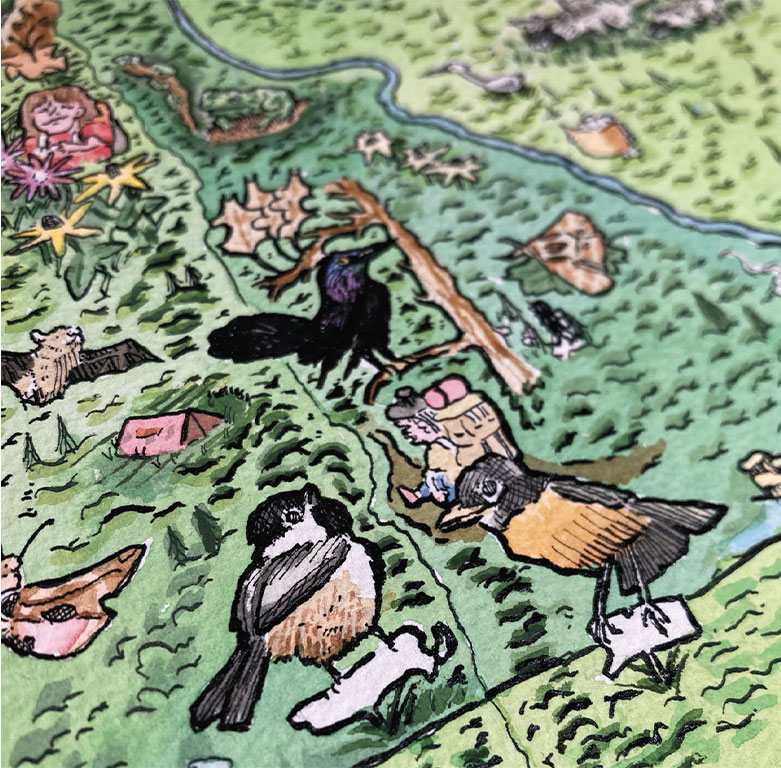
Illustration of birds by Sam Swap.
In addition to traditional printmakers and the Old Lyme artists, Swap’s work is informed by Hudson River School painters like Thomas Cole, who also hauled their paints, canvases, and easels deep into nature to work. But unlike Cole and other Transcendentalists who created idealized, artificial landscapes devoid of human activity, he works precisely at the intersection of the natural and built environments. You feel the struggle of a snapping turtle, for example, as it struggles to hurry across a road. For Swap these are more than simply aesthetic choices; they are essential questions about how humans categorize, define, and separate nature that demand our attention.
“It’s not a very idyllic scene, but it’s something that’s necessary in today’s life and can’t be ignored. It’s all about how we attribute this label to some animals to demote them in nature, like our own caste system,” he said. “And really, it’s helped me contextualize how I want to show these things in my art.”
In a world saturated with digital creatives and the growing presence of generative AI, his work feels uniquely tangible, almost nostalgic for a bygone era when art took not only craft, but also time. It’s an approach, he says, that is resonating not only with artists, but art lovers as well.
“Especially in this digital age, people are adopting a slower mentality and pushing back against the rush and crunch of our society to get stuff done fast; to get it now. I think adopting that slower mentality is a benefit. It is a new way that you can market yourself to say: I take my time; I am a person; and I made this intentionally,” he said. “Rather than like a big conglomerate, you’re now like an individual person. And I just find it so much more rewarding because people are like, ‘I didn’t know that this is a thing and they want a piece of it for themselves. I just find that fantastic.”
Timothy Brown is the editor of Connecticut Woodlands.