


Den Calls
The Hidden Lives of Winter Bears
By Laurie D. Morrissey
Photos by CT DEEP
In late November, Connecticut’s resident bears begin looking for a protected spot to spend the winter. They settle down in brush piles, beneath rocky outcrops, against uprooted trees, inside hollow trunks—even under convenient porches or decks.
Out of sight, out of mind? Not for folks who happen to notice a mother-and-cub bear ball under their shed. And not for the wildlife biologists keeping tabs on Connecticut’s largest land mammal. They’re making weekly house calls—or den calls—gathering data on physical condition, first-year survival rate, and other factors.
The black bear (Ursus americanus) is an impressive creature, glossy black or dark brown and weighing up to 500 pounds. An adult male is 2-3 feet tall at the shoulder, and 5-7 feet tall when standing. In Connecticut, where black bears were abundant in pre-colonial times, their population has fluctuated. European settlement reduced forest habitat, and hunting and trapping took their toll. By the mid-1800s, black bears were nearly extirpated from the state.
In the late 1800s, many farms were abandoned, and forests began to regenerate. Today, about 60% of Connecticut’s land is forested. The Connecticut Department of Energy and Environmental Protection (DEEP) estimates that there are about 1,200 black bears, and the population is growing by 5% to 7% a year. The concentration is highest in the northwest, but sightings are reported in every town.
They wake up if disturbed, and mother bears wake to care for their cubs.
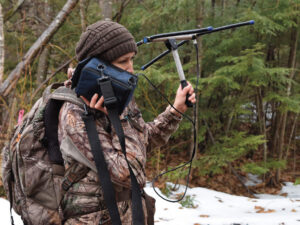
Melissa conducting telemetry using an antenna and receiver to pick up the radio collar’s frequency. This is how biologists track an animal with a transmitter
One fascinating aspect of black bears is their winter behavior. Contrary to popular belief, they are not true hibernators. In true hibernators (such as groundhogs and bats), there is a drastic reduction in body temperature, heart rate, and metabolism. Bears, on the other hand, spend the winter in a type of hibernation referred to as torpor or deep sleep. During this time, they do not drink, eat, urinate, or defecate. Heart rate and respiratory rate slow down, but body temperature drops only slightly. They wake up if disturbed, and mother bears wake to care for their cubs. Some males remain active, especially if the temperatures are mild and food is available.
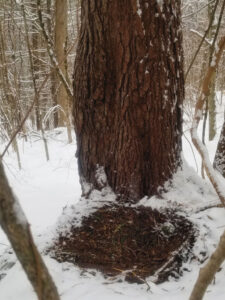
Example of a nest at the base of a large conifer. This is a common den-type of a sow with yearlings. This sow who denned here had 3 yearlings with her. They were treed at the time this photo was taken
Melissa Ruszczyk, with the DEEP Wildlife Division’s Furbearer/Black Bear Program, is one of the wildlife biologists conducting winter den surveys, which began in 2002.
“Our winter surveys allow us to obtain reproductive and survival estimates by visiting dens of collared bears,” she says. “Over time, we can see if there are changes in the litter sizes, weights, and the number of bears that survive their first year. We can document den-type selection, which can identify habitat types that are important for denning.” The information informs management decisions that help conserve bears, allow for continued range expansion, and provide the public with information and methods to mitigate human-bear conflicts and keep bears wild.
Some dens are not very den-like. “A female with a yearling may make a nest of twigs and pine needles at the base of a tree surrounded by thick shrubs,” Ruszcyk says. Their thick fur is water-repellent and insulating, so a snowfall doesn’t disturb them. Bears in ground nests are often found wearing a layer of white.
Well before they settle down, bears have an insatiable appetite. They eat almost constantly and can smell food up to two miles away. While the bulk of their diet consists of plants, they eat almost anything they can find, especially during this period of extreme hunger (called hyperphagia). They consume about 20,000 calories a day—instead of the usual 3,000-5,000—to accumulate fat.
Typically, females expecting cubs are the earliest denners. Inside her cozy winter home, a pregnant female breathes about once per minute and her heart beats 8-12 times per minute. Even in dormancy, she burns up to 4,000 calories a day.
Some males remain active, especially if the temperatures are mild and food is available.
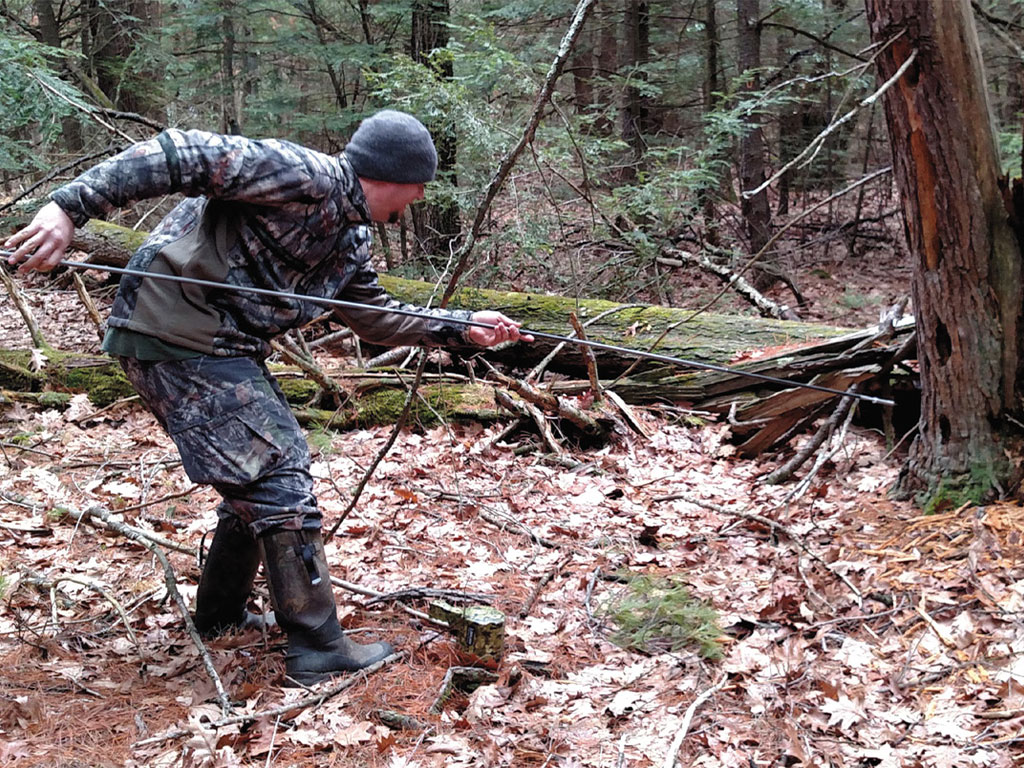
A biologist using a syringe pole to inject a bear with drugs. The bear is denned under the fallen tree
In January or February, Ruszczyk says, the female gives birth to a litter of one to four cubs. Two or three cubs are most common, but litter sizes appear to be increasing. Wildlife biologists attribute the increase at least in part to easily available food (such as garbage and bird seed), which improves maternal health.
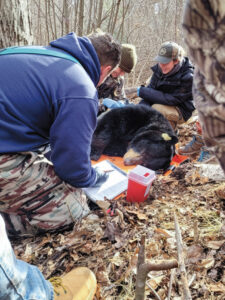
Biologists processing an anesthetized female bear. Measurements, biological samples, radio collar change, weights
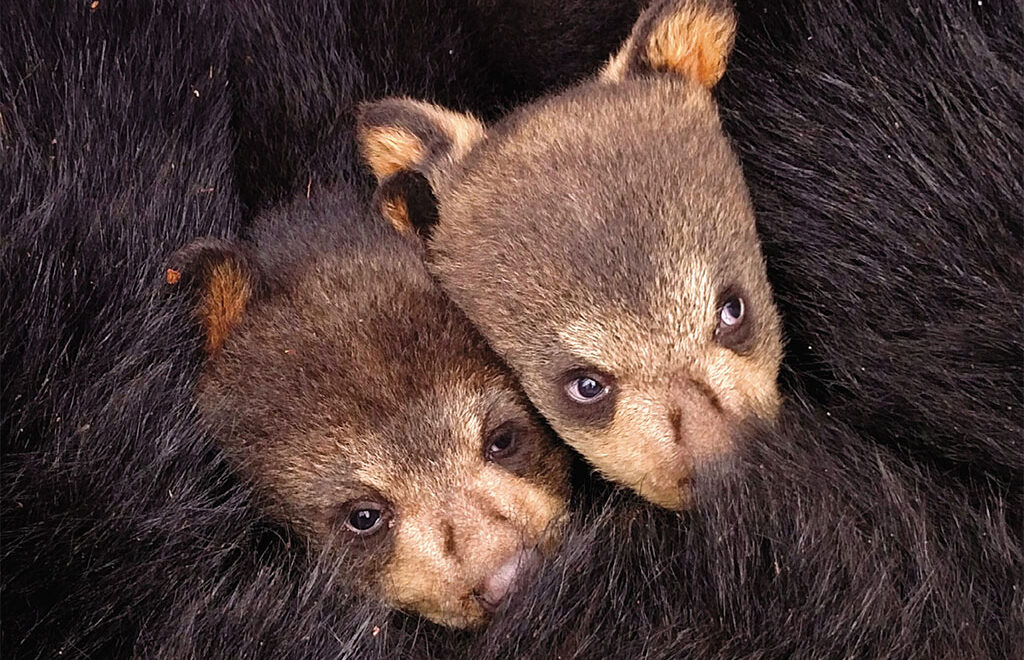
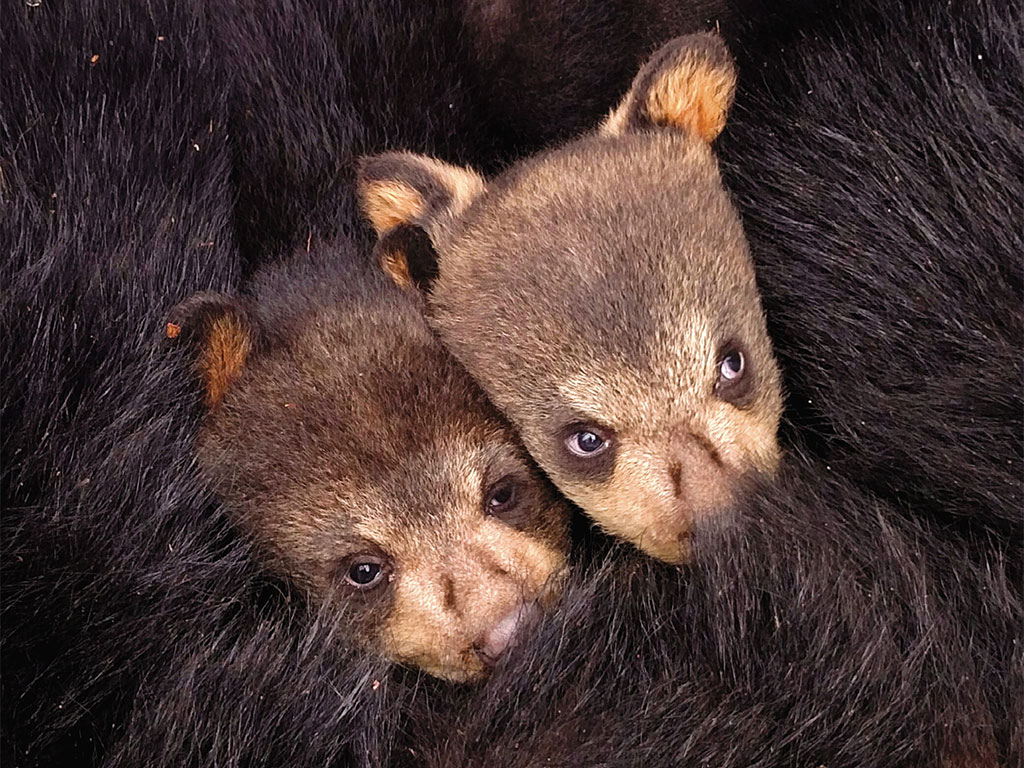
Although impregnation took place in early summer, fetal development only took place in the previous two months, when she had stored enough fat and nutrients. At birth, the cubs are blind and practically hairless, weighing less than a pound.
“Newborn cubs aren’t in a state of torpor; they’re required to eat, drink, urinate, and defecate so their bodies can grow,” Reszcyk explains. “They’re tended to regularly by the mother when they cry, and they nurse frequently to quickly gain weight on their mother’s high-fat milk.” By the end of winter, the nursing mother has lost a third or more of her body weight, and the cubs weigh about 4-6 pounds each.
To locate denning bears, biologists use GPS radio collars. Thirty females are collared this winter, according to Ruszczyk. She and her colleagues approach the den with their tools of the trade, including headlamp, dart guns, and a syringe on an 8-foot pole. Once the mother is anesthetized, they gently bring out the cubs and place them in a backpack to keep warm. Each cub gets a microchip tag on its ear and receives an ID number.
The biologists weigh and measure the mother, assess her overall condition, take blood and other samples, then give her a new collar with fresh batteries before sliding her back into the den.
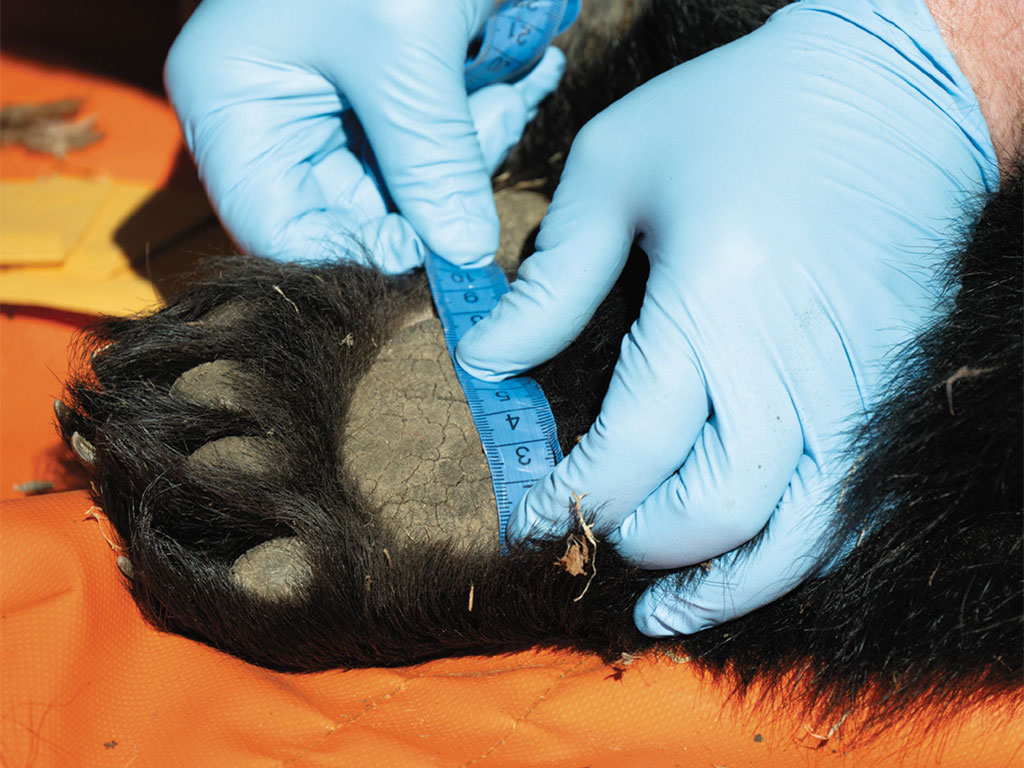
Taking a measurement of bear paw
The more data, the better, Ruszczyk says. They may even be able to track the effects of warmer winters on length of hibernation. With the bear population on the rise and human-bear encounters increasing, state biologists appreciate help from observant citizens. To report a bear sighting, email deep.wildlife@ct.gov.
Laurie D. Morrissey is a New Hampshire-based writer whose work has appeared in Connecticut Woodlands since 2016. She has also been published in Northern Woodlands, Art New England, New Hampshire Home, Appalachia, and numerous poetry journals.