A Natural Death
How the landscape of burial is changing in Connecticut and beyond.
By Britany Robinson
Glenn Cheney’s life is full of color. Nine years ago, at 65 years old, Cheney took up painting, and his depictions of flowers and forests cover a long wall in his kitchen. There are bursts of orange, yellow, and purple petals; stands of brown and white trees; and skies of stirring grays and blues. He plans on many more years of painting and sitting by the burbling stream in his backyard. In the warmer months, friends sometimes join him at the water for gin and tonics or a swim.
Like most people, Cheney doesn’t like to think about the end of his life. But what he really can’t stand is the idea of his body being placed in a dark, colorless box, or sent through an industrial furnace where it would release about 540 pounds of carbon on its way to becoming ash. Instead, he wants to return to nature, to give the nutrients in his body back to the soil where new life can grow. And he has a plan that gives him comfort: No fancy casket, no chemicals. He will be buried in a gently sloping field at the edge of Hanover Cemetery, about a mile from his house, in a section that’s recently been designated for green burials.
The Green Burial Council, a nonprofit that established industry standards and certification, defines green burial as an “environmentally-conscious approach to death care” that “prioritizes placing the body directly in the Earth, forgoing embalming, and using biodegradable materials.” There are no concrete vaults, and cotton shrouds or simple wooden coffins are used in place of polished wood and metals.
As concern for the climate crisis intensifies, so does awareness of the impact of our choices in all aspects of life. This includes how we die. Conventional burial practices result in significant resource extraction, land use, and carbon emissions. Cremation, the method of final disposition for 63% of Americans in 2025, requires the burning of fossil fuels, resulting in 360,000 metric tons of CO₂ in the U.S. each year.
Long before there were silk-lined caskets or formal funeral homes, what we now call “green” or “natural” burials were standard. Aspects of green burial have continued to be common practice for many, including those of Jewish and Muslim faith. Many indigenous peoples have maintained natural burial practices for millennia. But in the United States, where the funeral industry has formalized the memorialization and grieving process with catalogues of expensive caskets and urns, many are reconsidering and returning to this ancient practice.
Advocates for green burial see an opportunity to not only reduce the impact of death care, but also to nurture healthier relationships with the natural cycles of life and death.
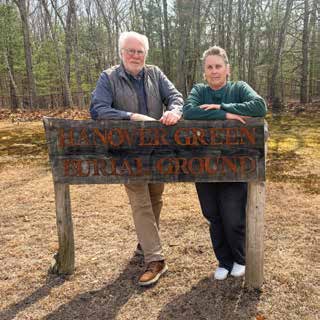
Glenn Cheney with Hanover Cemetery sexton, Jennifer Benson. Cheney crafted the sign for Hanover Green Burial Ground.
Cheney first learned of green burials from a friend, who had been thinking about her end-of-life options. She shared her interest in green burials with Cheney, who thought it made perfect sense. “It occurred to me,” he says, “that burying [in a coffin] prevents a lot of nutrients from returning to the environment, to the ecosystem we’re part of.”
The two started researching their options and found them surprisingly limited in Connecticut. Perhaps there was an opportunity here to start a natural cemetery themselves. So, they launched a nonprofit, called Connecticut Green Burial Grounds; built a simple website where they collected research to share with others; and then spent five years looking for land, in hopes of starting something new.
As concern for the climate crisis intensifies, so does awareness of the impact of our choices in all aspects of life. This includes how we die.
But they kept hitting roadblocks. “We went all over Connecticut, and we couldn’t find a place.” Properties for sale would be too close to wetlands or houses. They approached some land trusts about partnerships, but none were interested.
Eventually, Cheney struck up a conversation with members of the board of Hanover Cemetery. He delivered a presentation about the benefits of green burials, both environmental and economic. At first there was hesitation. But after some discussion and additional research, all board members agreed to designate half an acre at the edge of the cemetery to green burials, where bodies cannot be embalmed and all materials must be biodegradable. Markers are made of natural stone, placed flush with the ground. Families are encouraged to plant natives, and the meadow is only mowed once a year, in the fall, allowing for natural growth.
“We decided that we want to accommodate what people are looking to do,” says Jennifer Benson, sexton of Hanover Cemetery. “This seems to be the way people are going. Economically, it was a good decision.”
Sahara Farrugio, a Connecticut-based funeral planner and founder of Smart Funeral Planning, says interest in green burial is consistently strong in Connecticut. “People want something more natural or environmentally aligned,” she says. Often, they’re disappointed by what’s available in-state. Connecticut does not have any exclusively natural cemeteries. Hanover is one of five conventional cemeteries with a designated section for green burials. “People ultimately choose what’s available locally, such as hybrid cemeteries. A smaller number are motivated enough to look out of state to fully meet their goals.”
Angelina Silverio of Milford never imagined she’d be planning a funeral this year. But when her baby, Ava, died on the day of her birth, Silverio and her family were faced with the devastating task of finding a cemetery. Nothing felt right.
“I’ve had a lot of loss in my life,” says Silverio. “I’m familiar with the traditional funeral route. But I kept thinking, there has to be something else. I don’t want a depressing cemetery— I just want a pretty spot.”
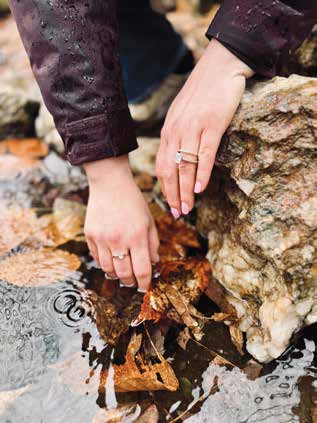
Angelina Silverio dips her hands in a creek near Ava’s plot.
She and her family toured several green cemetery options in Connecticut, but she says they all felt like an afterthought, tucked behind the familiar rows of granite headstones.
Silverio eventually found what she was looking for in Vermont Forest Cemetery, a three-hour drive from her home in Milford. The distance is not ideal, but in looking at photos of the peaceful forest and in speaking to the founder, Michelle Hogle Acciavatti, she knew this was the place for her daughter. On a day between two snowstorms, the family drove up to honor Ava at an intimate graveside ceremony. The plot was beneath a big tree that would provide shade come spring, right next to a pretty creek. Acciavatti read a poem, and her toddler son played with Ava’s big sister, Amelia, in the snow. Everything was soft and white.
“It was really hard,” Silverio says. “But it just felt right.”
At Vermont Forest Cemetery, there are no mowed lawns or headstones. Plots are dug between trees, among 56 acres of upland mixed hardwood forest. In 2017, Acciavatti and a group of green burial advocates successfully lobbied to change state law, decreasing the required depth of burial from five to 3.5 feet. The change was critical in the legalization of green burials, as bodies must be placed in the active layer of soil, where oxygen, soil, and warmth aid in breakdown and nutrients cycle through. She opened Vermont Forest Cemetery, the first of its kind in Vermont, in 2023.
Years ago, the land was heavily logged. “We’re hoping to restore [the forest] to a healthy balance,” says Acciavatti. “Not the health of the 1800s, but the health it needs to survive into the next century.” After burial, the plots are left to rewild. A partnership with White River Natural Resources Conservation District guarantees that the land, and the plots in which people are buried, are protected from development in perpetuity.
When a tree dies and falls in the forest, it breaks down to support other living things. Small animals find shelter among the fallen branches. Rain softens the wood. Moss grows. As leaves, branches, and trunk decompose, the tree material mixes with soil on the ground and becomes nutrient-rich humus, which helps prevent erosion, retains soil moisture, and feeds new life. “Humus” and “human” both have Latin roots that mean “earth.” While studies are limited when it comes to the impact of human burial on soil health, we know that decomposition plays a critical role in the health of an ecosystem.
“Land can be enhanced by burial,” says Lee Webster, Co-founder of the Conservation Burial Alliance. Vermont Forest Cemetery aligns with best practices for conservation burial, a specific type of green burial that combines earth-friendly methods with conservation partnerships, allowing burial grounds to be a tool for protecting—even rehabilitating— the land. There are currently no conservation burial grounds in Connecticut.
When a tree dies and falls in the forest, it breaks down to support other living things.
Webster has done a lot of work in trying to convince land trusts of the benefits of partnering with nonprofits in the establishment of conservation burial grounds. She says it’s difficult to get these environmental groups interested in the business of burying the dead. But Webster thinks that for those with an open mind, conserving land and creating final resting places for humans is a natural fit.
“We’re both dealing with deep time,” she says. “Conservation means conservation forever. Burial means burial forever.”
People who choose green or conservation burial are often doing so because they feel a connection to a place and the earth. By returning to a natural cycle, there is a comforting continuation of life. Loved ones often find comfort in this process, too.
At Vermont Forest Cemetery, the experience of the living is a priority. In a documentary about conservation burial, Acciavatti describes the process of burial for families: “Instead of leaving the casket or body on top of the grave, people come and lower the body into the grave.” She says this can make it easier to walk away, “because you know you’ve come to give that body back to the earth.” The forest operates as a burial ground, but they also host art installations, educational programming, and even a kids’ summer camp.
“We believe humans are part of the ecosystem,” says Acciavatti. “We’re interacting with this environment on a daily basis.”
Conservation groups rely on the support of people who feel connected to the places they protect and the ecosystems they restore. Land trusts build trails, host birdwatchers, and teach people about wildlife. To have a family member buried in a plot of land is another layer of connection to that place.
“We’re both dealing with deep time. Conservation means conservation forever. Burial means burial forever.”
“If I have someone buried on conservation land, I’m going to support that land trust,” says Webster. “I’m going to be excited when they build a foot bridge and I can bring my kids and enjoy that place because I feel connected to it. Land trusts are just starting to come around to the idea of using burial as a conservation strategy, which will have resounding impacts on the natural burial movement and community conservation once it is normalized.”
A lot will need to change in Connecticut for conservation burial grounds like Vermont Forest Cemetery to exist someday. Roadblocks remain, both cultural and regulatory. For now, an increasing number of conventional cemeteries are opening up to the idea of green burial, as more people learn about them and express interest. Connecticut Green Burial Grounds was dissolved as a nonprofit in 2025, but the website is still up for anyone who is searching for information.
Glenn Cheney has told all of his friends about the new green burial section at Hanover. His neighbor bought five plots for herself and her family. When asked what kind of tree he’d like planted on his own plot someday, Cheney says he’d be happy with any tree. “As long as it provides shade to whoever visits.”
Britany Robinson is the editor of Connecticut Woodlands.