
The Challenge of Trails and Time
Recording the details of 800 miles
By Mark S. Weiner
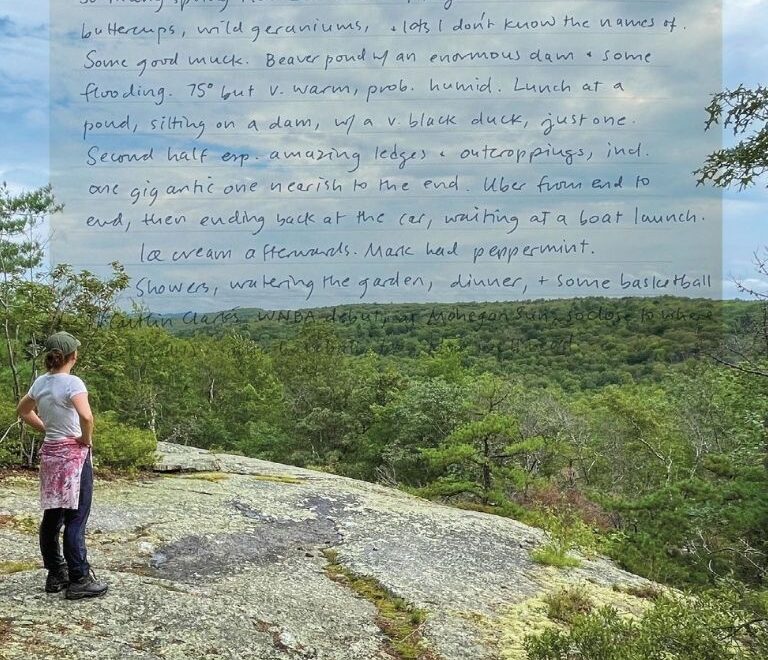
For the past twenty-some years, my wife and I have been taking notes about the trails we have walked. Stephanie writes them by hand into lap-sized spiral notebooks as part of our evening routine. A slightly bowed wooden shelf in our den shelters these treasured “fun logs,” from which we read aloud whenever we feel moved to recollect our adventures.
One of these notes marks the moment when the two of us, both transplants to Connecticut, began to appreciate that the handful of trails with pretty blue blazes that we had recently hiked were, in fact, parts of an entire trail system—a network of paths that we now recognize as one of the jewels of our adopted state.
11/27/08. We hiked the 2.2 miles into the Indian Council Caves, Thanksgiving Day. A bit steep at first, but not difficult. The caves are amazing. Very impressively huge and gravity-defying. The Tunxis is a “blue-blazed trail” so this is a very well-marked and easy to follow trail. Lots of Mountain Laurel.
When we first began CFPA’s Blue-Blazed Hiking Trails Challenge, we just wanted the 50-miler patch—we thought it would probably end there. How wrong we were! The challenge involves four levels: 50, 200, 400, and 800 miles of hikes completed on blue-blazed trails, with prizes for each one. Once we got the 50-mile patch, we were hooked on the fun. Could we do 200? 400? We kept going, and gradually, the challenge became something much more meaningful.
In March of this year, we stood at the trailhead of the newest path of the blue-blazed network, the Wabbaquasset, and I wrote the following:
Our final hike. We are done. It was perfect. A chilly, sunny morning. The trees sang to us during our final steps.
Eight hundred miles! We were elated. Yet something also put us in a sober mood. We were no longer young people settling into our first home in suburban Hamden. We were now in our fifties—me, almost sixty. Together on the trails of Connecticut, we had grown a good deal older. Time had passed.
Stephanie and I began hiking in this forested state partly to deepen our appreciation for our adopted home. We also wanted to find refuge from the demands of our busy lives. Stephanie hails from Minnesota, and I was born and raised in Los Angeles, so we often find ourselves on a plane to visit family. Our careers are demanding. Our emails never stop pinging. To walk the trails was a way to steal back lost time. We wanted to “live life deliberately,” as Thoreau wrote in Walden. We also wanted to get to know our adopted home. The CFPA challenge, which we began to pursue in earnest in 2020, spurred us on.
At first, we simply hiked whenever the spirit moved us, and to whatever part of the state we thought might be interesting. Our lives don’t lend themselves much to monthly hiking goals—we just stuck with it, sometimes more, sometimes less, and we tried to find new routes to explore whenever that seemed like fun. But over time, managing the challenge required spreadsheets and careful planning to make sure we were being moderately efficient. After all, now we weren’t simply after a patch: we wanted the prized vest!
Toward the end, a bit of psychological obsession helped, too, driving us well beyond a rational calculus for fun: “Miles! I want more miles!” I would exclaim as we loaded our gear into the car.
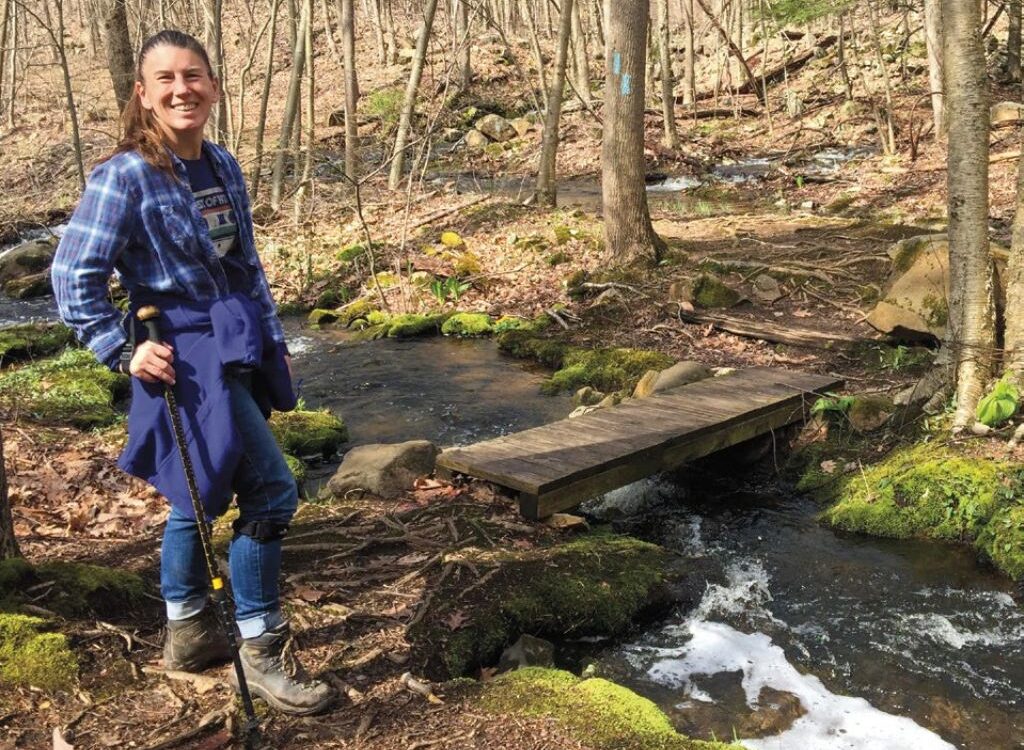
Stephanie on the Quinnipiac Trail
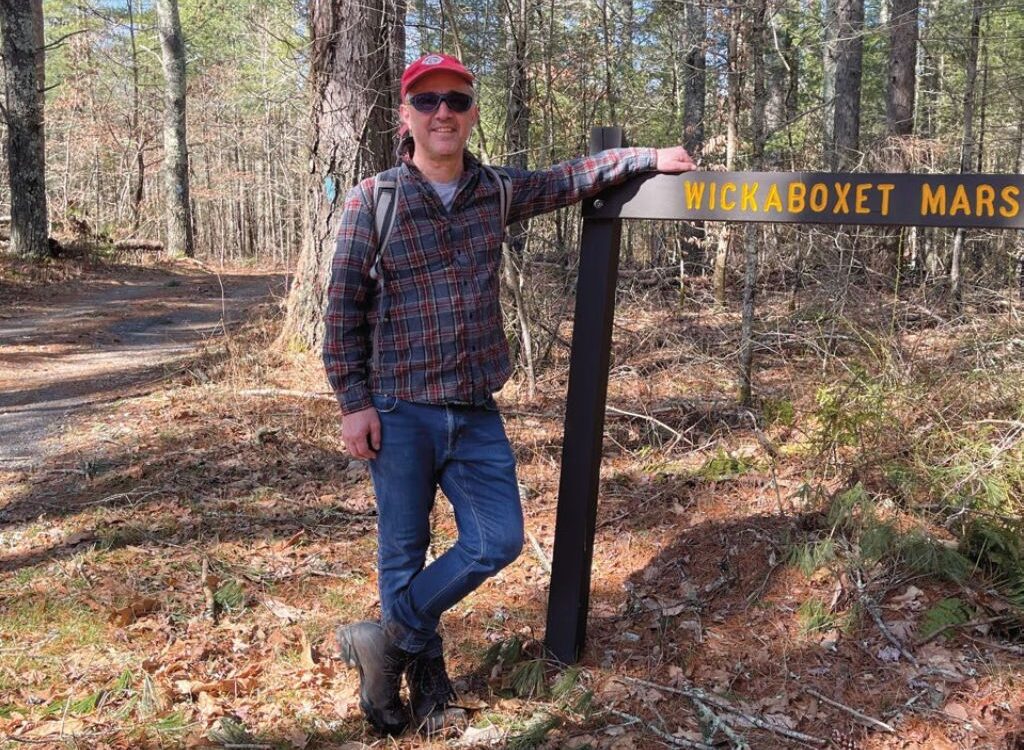
Mark on the Pachaug Trail
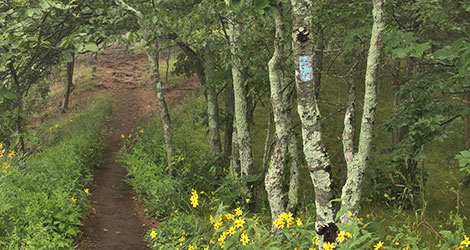
On the trails, we saw so many wonderful things, both majestic and mundane, and we’re grateful now to have our notebooks to be reminded of them. The gorgeous panorama at the top of Mohawk Mountain. Trees swaying in Nipmuck Forest after a summer storm. A path lined with blue and pink wildflowers. Countless good dogs (shout-out to Canyon, Margo, Prudence, Juno, Mia, and Lucy—where are you now?). Unusual formations of traprock. The bear that ambled in front of our car in the northwest corner.
It’s been important to us to recall the hard parts, too, the accidents, mistakes, and unwelcome surprises, all likewise carefully recorded. The bugs that swarmed us near the Rhode Island border on the Pachaug. The time we fell into a stream on the Mattabesset, in a sudden, total loss of dignity (which eventually left us laughing). An ill-advised hike, knee-deep in snow, two miles along Hancock Brook—couldn’t we have waited another couple of weeks for spring? The time that a stumble over some sharp rocks made us wonder if we could safely make it home.
The magic of recollecting all these moments now stems not only from their significance on the trails, but how those miles wove themselves into our lives. Triumphs and disappointments. Jobs that came and went. Family and friends lost. Thanks to the blue-blazed challenge, our memories of these events have become entwined with the memories of our hikes, and so our past, as much as our present, has become inextricable from the Connecticut landscape.
The granular knowledge of the state that we gained while seeing it on foot, at a human pace, over many years, is linked with all the other great turning points, and all the common events, that we experienced together as a couple.
Today as we drive toward Litchfield, then, we might pass the crossing for the Mattatuck—there it is!—and think: “We hiked this trail the day we heard about your award—I was so proud.” We roll past Finch Brook: “You and I were here the weekend the storm blew down the great tree in our yard.” Naugatuck: “We were walking here when you decided to leave your job.” Metacomet: “When we hiked that trail, we talked about your film.” Narragansett: “Our dear friend was having surgery when we walked this path.” Cockaponset: “This is where we were when things were getting better.”
These days our lives and our memories are so often tied to a placeless world that is at once everywhere and nowhere. The digital age seems to be prying apart our connections to time and place. And it is prying it apart fast.
To reconnect these aspects of experience seems to me to be among the most important spiritual tasks of our time.
It also seems to be a task to which a trail challenge is well suited. A trail challenge requires us to be deeply in the physical world, to experience a place in person. What’s more, an extended challenge—one that seems almost impossibly long—strikes me as especially tailored for the job, because it can only be completed over a period of years.
As transplants to Connecticut, the 800-mile challenge also helped us with a less spiritually grand yet personally important task. Through it, we came to identify ourselves with Connecticut, to know the state. Through every step, we’ve made it our own.
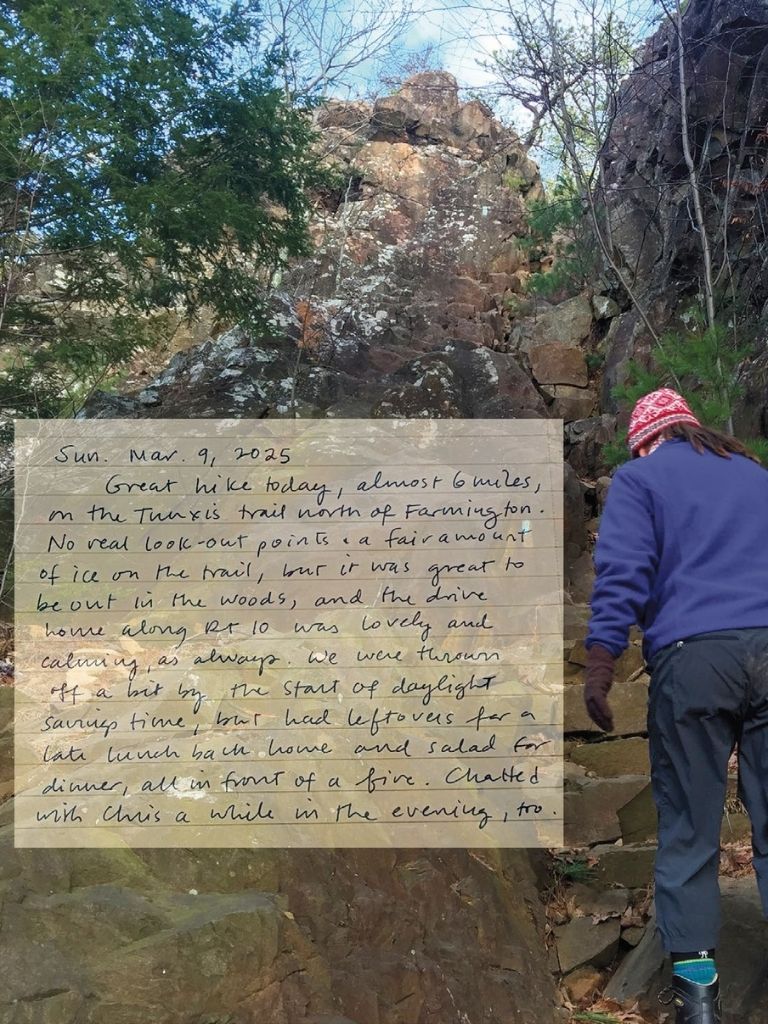
The magic of recollecting these moments now stems not only from their significance on the trails, but how those miles wore themselves into our lives.
A few weeks after we completed the 800-mile challenge—after I had returned from another trip to the other side of the country—Stephanie and I sat next to each other at home in our vests, and we wondered whether we should take up another challenge. Our first thought was to visit every state park in Connecticut, or every local historical museum. Then we considered hiking the New England Trail through Massachusetts. Maybe we should read every Shakespeare play in chronological order? We had so many ideas!
“Those all sound great,” I said. “Let’s talk about them more on a neighborhood walk.”
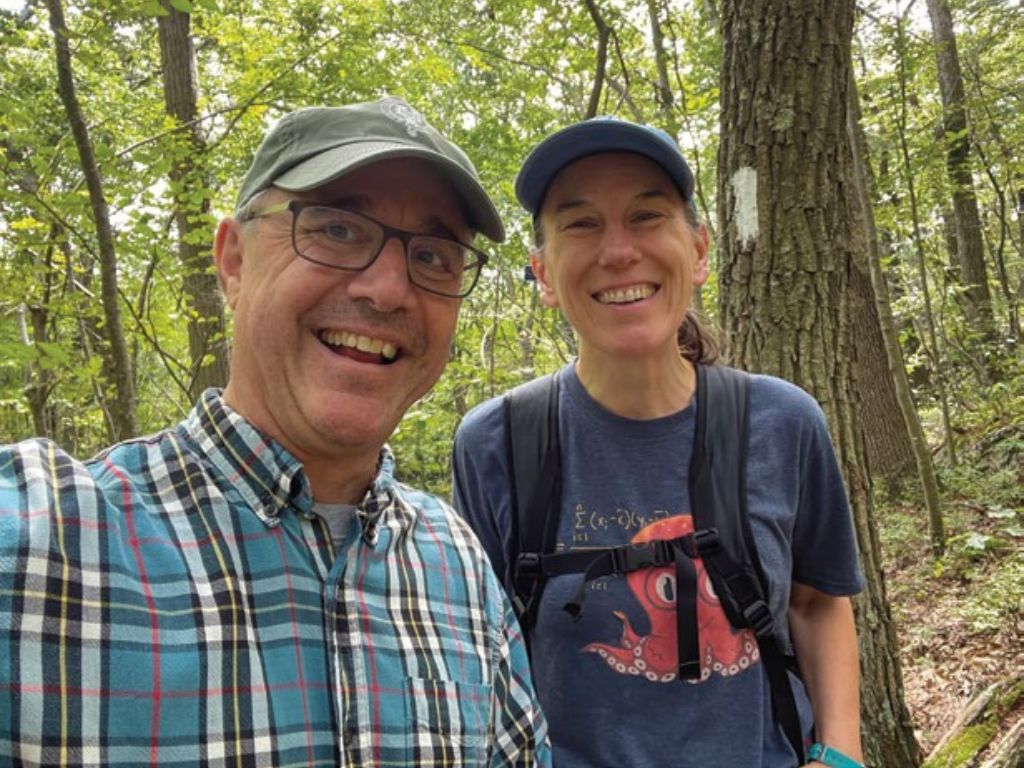
Mark and Stephanie on the Appalachian Trail.
Mark S. Weiner is a documentary filmmaker and former law professor who lives in Hamden. His most recent film, “The Volunteers: Mountain Rescue Brings Us Home” is available for streaming on PBS Passport and, in longer form, on Prime Video. He and his wife, a professor of English at Wesleyan, are Giant Masters for All Seasons.