
On the Trail
Slower Miles on the Nipmuck Trail
In her poem Sometimes, Mary Oliver wrote, “Instructions for living a life: Pay attention. Be astonished. Tell about it.” These are not only words I live by; they are words I walk by. Slow, deliberate, intentional – I do not get anywhere quickly when I am outside.
Words and photos by Michelle Poudrette
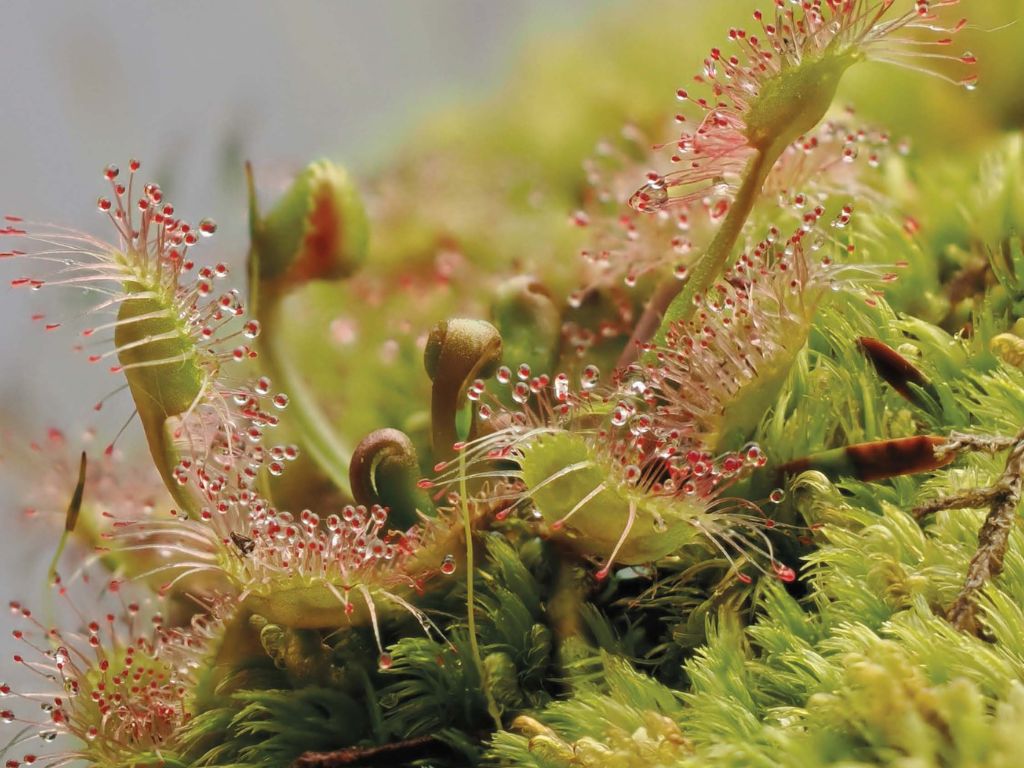
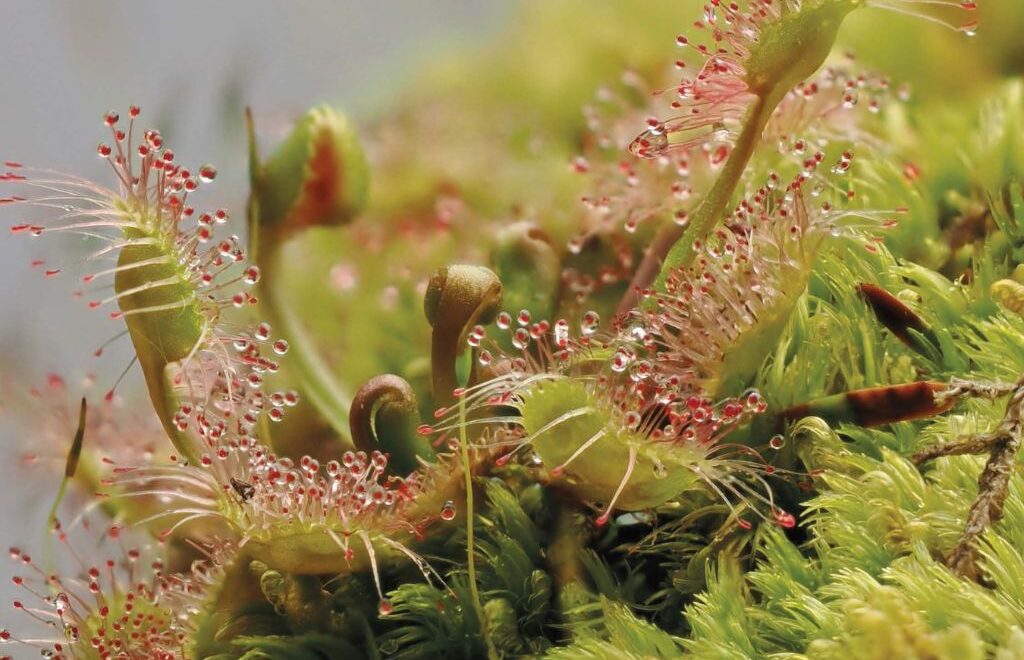
Sundew. Photos by Michelle Poudrette.
My love of nature took root in my youth, on the Old Furnace Trail in Killingly, where I grew up. I am neither a forester nor an ecologist. My background is in elementary education and literacy development. But in 2013, my life was forever changed when I was accepted into and completed the Texas Master Naturalist course in Austin. Since returning to CT in 2016, I’ve worked for and volunteered with numerous conservation organizations. In 2017, I had the great privilege of attending the James L. Goodwin Master Naturalist program. Through these programs, I’ve learned to view my time on trails as an opportunity to connect, learn and grow as both a naturalist and an advocate.
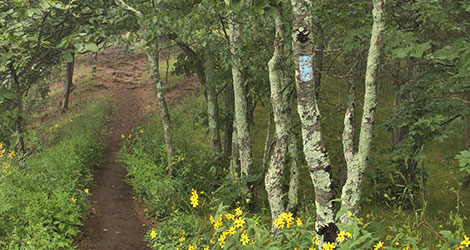
I have hiked along various sections of the Nipmuck Trail more times than I can count. But to be honest, I’d be hard pressed to call what I do “hiking.” It’s a slow saunter more focused on savoring every moment than getting anywhere in a timely manner. I stop often to crouch down low, to inspect a plant closely, to photograph its delicate details. Perhaps that’s why I love the hilly, northernmost sections of the Nipmuck Trail the most. The undulation lends itself well to a slow pace with frequent stops. The flora helps, too.
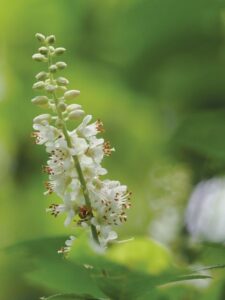
Coastal Sweet Pepperbush. Photos by Michelle Poudrette.
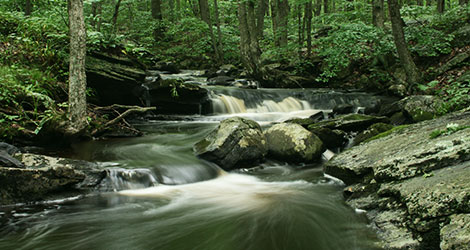
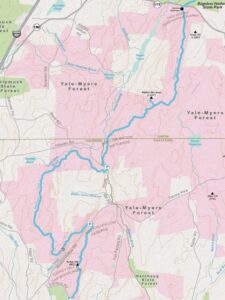
The stretch of trail from Yale-Myers Forest to Bigelow Hollow State Park and Nipmuck State Forest is unlike any stretch of trail that I know of in easter Connecticut. With deeply shaded hemlock groves, moss-covered boulders, and remote beaver ponds it feels ancient and wild. Of course, these forests, like most in our region, aren’t particularly old. There may be pockets of “old growth” stands but I’m not aware of them. It’s not the age of these forests but rather their expanse that makes them so unique and extraordinary. Over 40,000 acres of protected land in this area have created a vast wildlife corridor in which plants and animals can live, grow, and flourish. You can feel it in the air. This is a special place, worthy of lingering.
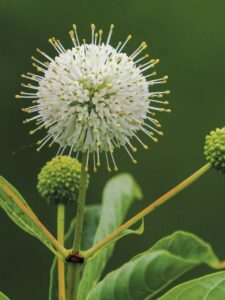
Above right: Buttonbush. Photos by Michelle Poudrette.
For someone like me who loves native plants, this 12-mile stretch of trail is a goldmine. In a single day on the trail, I may encounter my favorite carnivorous bog plants like purple pitcher plants (Sarracenia purpurea) and sundews (Drosera spp.); the not-so-common bristly clubmoss (Spinulum annotinum); numerous orchid species; and my favorite understory shrubs and trees, such as hobblebush (Viburnum lantanoides) and striped maple (Acer pensylvanicum). From blunt-lobed hepatica (Anemone americana) to witch-hazel (Hamamelis virginiana), there are native plants blooming here from March to October. In the winter months, the mosses, fungi, lichens, and evergreen ferns take the spotlight. Once you start paying attention, a whole new world awaits. Since plant life supports all life, slowing down to inspect a bud or bloom gives you time to also spot the caterpillar feeding on a leaf or newts searching for food on the forest floor below.
For some native plant enthusiasts, it’s all about finding rare or endangered species, the “lifers” that complete a bucket list of plants to see. While I certainly enjoy finding rare plants from a conservation perspective, and I have found many along the Nipmuck Trail, I also cherish the common and familiar plants, those that I recall from my youth like jewelweed (Impatiens Capensis) and buttonbush (Cephalanthus occidentalis). Rather than measuring my time on the trail by miles, I measure it by moments of wonder and gratitude for these plants and habitats and for the people who work tirelessly to protect them. I’m not getting anywhere quickly on trails, and I wouldn’t have it any other way.
Michelle Poudrette is an educator, naturalist, and conservation professional who hails from northeast Connecticut. When she is not directly supporting organizations that help protect and connect people to nature, she is out botanizing the blue-blazed trails and beyond.